
Ch 27: Current and Resistance
Knight Calc - Physics for Scientists and Engineers 5th Edition
Knight Calc5th EditionPhysics for Scientists and EngineersISBN: 9780137344796Not the one you use?Change textbook
Chapter 27, Problem 65a

You've decided to protect your house by placing a 5.0-m-tall iron lightning rod next to the house. The top is sharpened to a point and the bottom is in good contact with the ground. From your research, you've learned that lightning bolts can carry up to 50 kA of current and last up to 50 μs. How much charge is delivered by a lightning bolt with these parameters?

Verified step by step guidance
1
Identify the given values: The current carried by the lightning bolt is \( I = 50 \text{kA} = 50,000 \text{A} \), and the duration of the lightning bolt is \( t = 50 \mu\text{s} = 50 \times 10^{-6} \text{s} \).
Recall the relationship between charge, current, and time: \( Q = I \cdot t \), where \( Q \) is the charge, \( I \) is the current, and \( t \) is the time.
Substitute the given values into the formula: \( Q = (50,000 \text{A}) \cdot (50 \times 10^{-6} \text{s}) \).
Simplify the expression by multiplying the current and time to calculate the total charge delivered by the lightning bolt.
Express the result in coulombs (C), as charge is measured in this unit, and ensure the final value is in proper scientific notation if necessary.

Verified video answer for a similar problem:

This video solution was recommended by our tutors as helpful for the problem above.
Was this helpful?

Key Concepts

Here are the essential concepts you must grasp in order to answer the question correctly.

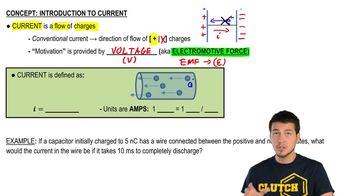
Current

Current is the flow of electric charge in a circuit, measured in amperes (A). In the context of lightning, the current can be extremely high, as indicated by the 50 kA mentioned in the question. This high current results from the rapid movement of electrons during a lightning strike, which can deliver a significant amount of energy in a very short time.
Recommended video:
Guided course
05:38
Intro to Current

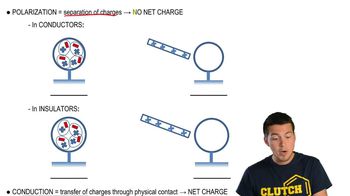
Charge

Electric charge is a fundamental property of matter that causes it to experience a force when placed in an electromagnetic field. Charge is measured in coulombs (C). The total charge delivered by a lightning bolt can be calculated using the formula Q = I × t, where Q is the charge, I is the current, and t is the time duration of the current flow.
Recommended video:
Guided course
06:36
Charging Objects

Time Duration

Time duration refers to the length of time that an event occurs. In the case of a lightning strike, the duration is typically very short, often in the microsecond range, as indicated by the 50 μs in the question. This brief time frame is crucial for calculating the total charge delivered, as it directly influences the amount of charge that flows during the lightning event.
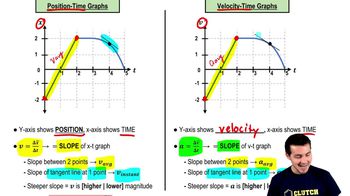
Recommended video:
Guided course
05:59
Velocity-Time Graphs & Acceleration
Related Practice
Textbook Question

You've decided to protect your house by placing a 5.0-m-tall iron lightning rod next to the house. The top is sharpened to a point and the bottom is in good contact with the ground. From your research, you've learned that lightning bolts can carry up to 50 kA of current and last up to 50 μs. You don't want the potential difference between the top and bottom of the lightning rod to exceed 100 V. What minimum diameter must the rod have?

1
views
Textbook Question

A 2.0-mm-diameter wire formed from a composite material has a resistivity that decreases with distance along the wire as ρ=ρ₀e−αx, where ρ₀=4.0×10⁻⁵ Ω m, x (in m) is measured from one end of the wire, and the constant α=4.0 m−1. What is the resistance of a 50-cm-long length of this wire?

2
views
Textbook Question

An aluminum wire consists of the three segments shown in FIGURE P27.64. The current in the top segment is 10 A. For each of these three segments, find the current density J. Place your results in a table for easy viewing.

2
views
Textbook Question

Two 10-cm-diameter metal plates 1.0 cm apart are charged to ±12.5 nC. They are suddenly connected together by a 0.224-mm-diameter copper wire stretched taut from the center of one plate to the center of the other. Does the current increase with time, decrease with time, or remain steady? Explain.

2
views
Textbook Question

An aluminum wire consists of the three segments shown in FIGURE P27.64. The current in the top segment is 10 A. For each of these three segments, find the drift velocity vd. Place your results in a table for easy viewing.

1
views
Textbook Question

The two wires in FIGURE P27.63 are made of the same material. What is the electron drift speed in the 2.0-mm-diameter segment of the wire?

1
views