
Ch 27: Current and Resistance
Knight Calc - Physics for Scientists and Engineers 5th Edition
Knight Calc5th EditionPhysics for Scientists and EngineersISBN: 9780137344796Not the one you use?Change textbook
Chapter 27, Problem 70b

Two 10-cm-diameter metal plates 1.0 cm apart are charged to ±12.5 nC. They are suddenly connected together by a 0.224-mm-diameter copper wire stretched taut from the center of one plate to the center of the other. Does the current increase with time, decrease with time, or remain steady? Explain.

Verified step by step guidance
1
Step 1: Understand the physical setup of the problem. Two metal plates are charged to ±12.5 nC and connected by a copper wire. The plates act as a capacitor, and the wire provides a path for the charges to flow, creating a current. The question asks about the behavior of this current over time.
Step 2: Recall the concept of a discharging capacitor. When a capacitor is connected through a conductor, the charges on the plates flow to neutralize each other. The current is initially high because the potential difference between the plates is large, but it decreases over time as the charge on the plates diminishes.
Step 3: Use the formula for the current in a discharging capacitor: \( I(t) = I_0 e^{-t/RC} \), where \( I_0 \) is the initial current, \( R \) is the resistance of the wire, \( C \) is the capacitance of the plates, and \( t \) is time. This equation shows that the current decreases exponentially with time.
Step 4: Consider the physical properties of the wire and plates. The resistance \( R \) of the copper wire can be calculated using \( R = \frac{\rho L}{A} \), where \( \rho \) is the resistivity of copper, \( L \) is the length of the wire, and \( A \) is its cross-sectional area. The capacitance \( C \) of the plates can be calculated using \( C = \frac{\varepsilon_0 A}{d} \), where \( \varepsilon_0 \) is the permittivity of free space, \( A \) is the area of the plates, and \( d \) is the separation between them.
Step 5: Conclude that the current decreases with time. This is because the charge on the plates diminishes as the capacitor discharges, reducing the potential difference and, consequently, the current flowing through the wire. The exponential decay behavior is characteristic of a discharging capacitor.

Verified video answer for a similar problem:

This video solution was recommended by our tutors as helpful for the problem above.
Was this helpful?

Key Concepts

Here are the essential concepts you must grasp in order to answer the question correctly.

Capacitance

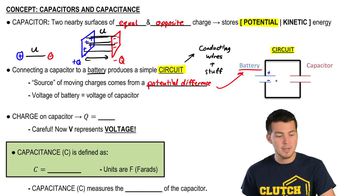
Capacitance is the ability of a system to store electric charge per unit voltage. In this scenario, the two metal plates form a capacitor, where the capacitance depends on their area and the distance between them. When charged, the plates create an electric field, and the stored energy can influence the current flow when they are connected.
Recommended video:
Guided course
08:02
Capacitors & Capacitance (Intro)

Current Flow in Circuits

Current is the flow of electric charge through a conductor, measured in amperes. When the charged plates are connected by a wire, the potential difference between them drives the current. The behavior of the current over time is influenced by the capacitance of the plates and the resistance of the wire, which can cause the current to change as the system reaches equilibrium.
Recommended video:
Guided course
11:08
Flow Continuity

RC Time Constant

The RC time constant is a measure of the time it takes for the current to charge or discharge in a resistor-capacitor circuit. It is calculated as the product of resistance (R) and capacitance (C). In this case, as the plates discharge through the wire, the current will initially be high and then decrease over time, following an exponential decay governed by the RC time constant.
Recommended video:
Guided course
08:59
Phase Constant of a Wave Function
Related Practice
Textbook Question

A 300 μF capacitor is charged to 9.0 V, then connected in parallel with a 5000 Ω resistor. The capacitor will discharge because the resistor provides a conducting pathway between the capacitor plates, but much more slowly than if the plates were connected by a wire. Let t=0 s be the instant the fully charged capacitor is first connected to the resistor. At what time has the capacitor voltage decreased by half, to 4.5 V?

1
views
Textbook Question

You've decided to protect your house by placing a 5.0-m-tall iron lightning rod next to the house. The top is sharpened to a point and the bottom is in good contact with the ground. From your research, you've learned that lightning bolts can carry up to 50 kA of current and last up to 50 μs. You don't want the potential difference between the top and bottom of the lightning rod to exceed 100 V. What minimum diameter must the rod have?

1
views
Textbook Question

A 2.0-mm-diameter wire formed from a composite material has a resistivity that decreases with distance along the wire as ρ=ρ₀e−αx, where ρ₀=4.0×10⁻⁵ Ω m, x (in m) is measured from one end of the wire, and the constant α=4.0 m−1. What is the resistance of a 50-cm-long length of this wire?

2
views
Textbook Question

You've decided to protect your house by placing a 5.0-m-tall iron lightning rod next to the house. The top is sharpened to a point and the bottom is in good contact with the ground. From your research, you've learned that lightning bolts can carry up to 50 kA of current and last up to 50 μs. How much charge is delivered by a lightning bolt with these parameters?

1
views