
Textbook Question
Two small charged spheres are 5.0 cm apart. One is charged to +25 nC, the other to −15 nC. A proton is released from rest halfway between the spheres. What is the proton's speed after it has moved 1.0 cm?
1
views

 Verified step by step guidance
 07:33
07:33
 07:31
07:31 04:12
04:12Two small charged spheres are 5.0 cm apart. One is charged to +25 nC, the other to −15 nC. A proton is released from rest halfway between the spheres. What is the proton's speed after it has moved 1.0 cm?
A −10.0 nC point charge and a +20.0 nC point charge are 15.0 cm apart on the x-axis. What is the electric potential at the point on the x-axis where the electric field is zero?
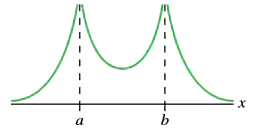
Two point charges qₐ and qᵦ are located on the x-axis at x=a and x=b. FIGURE EX25.36 is a graph of V, the electric potential. Draw a graph of Eₓ, the x-component of the electric field, as a function of x.
Two point charges 2.0 cm apart have an electric potential energy −180 μJ. The total charge is 30 nC. What are the two charges?
The two halves of the rod in FIGURE EX25.35 are uniformly charged to ±Q. What is the electric potential at the point indicated by the dot?
Four small spheres, each charged to +15 nC, form a square 2.0 cm on each side. From far away, a proton is shot toward the square along a line perpendicular to the square and passing through its center. What minimum initial speed does the proton need to pass through the square of charges?