Ch 25: The Electric Potential
Knight Calc - Physics for Scientists and Engineers 5th Edition
Knight Calc5th EditionPhysics for Scientists and EngineersISBN: 9780137344796Not the one you use?Change textbook
Chapter 25, Problem 37

Two point charges 2.0 cm apart have an electric potential energy −180 μJ. The total charge is 30 nC. What are the two charges?

Verified step by step guidance
1
Start by recalling the formula for electric potential energy between two point charges: U = (kq1q2)r, where U is the potential energy, k is Coulomb's constant (8.99 × 10⁹ N·m²/C²), q1 and q2 are the charges, and r is the distance between them.
Substitute the given values into the formula: -180 × 10-6 J = (8.99 × 10⁹ × q1 × q2)0.02. Rearrange the equation to solve for the product of the charges: q1q2 = (-180 × 10-6 × 0.02)8.99 × 10⁹.
Next, use the fact that the total charge is given as q1 + q2 = 30 × 10-9 C. Let q1 = x and q2 = 30 × 10-9 - x.
Substitute q1 and q2 into the product equation: x × (30 × 10-9 - x) = (-180 × 10-6 × 0.02)8.99 × 10⁹. Expand and simplify the equation to form a quadratic equation in terms of x.
Solve the quadratic equation using the quadratic formula: x = -b ± b2 - 4ac2a, where a, b, and c are the coefficients of the quadratic equation. The two solutions will give the values of q1 and q2.

Verified video answer for a similar problem:

This video solution was recommended by our tutors as helpful for the problem above.
Was this helpful?

Key Concepts

Here are the essential concepts you must grasp in order to answer the question correctly.

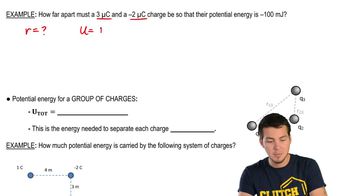
Electric Potential Energy

Electric potential energy is the energy a charged object possesses due to its position in an electric field. It is defined as the work done to move a charge from a reference point to a specific point in the field. The formula for the potential energy (U) between two point charges (q1 and q2) separated by a distance (r) is given by U = k * (q1 * q2) / r, where k is Coulomb's constant.
Recommended video:
Guided course
07:51
Electric Potential Energy

Coulomb's Law

Coulomb's Law describes the force between two point charges. It states that the magnitude of the electrostatic force (F) between two charges is directly proportional to the product of the magnitudes of the charges and inversely proportional to the square of the distance between them. Mathematically, it is expressed as F = k * (|q1 * q2|) / r², where k is Coulomb's constant. This law is fundamental in understanding the interactions between charged particles.
Recommended video:
Guided course
09:52
Coulomb's Law

Charge Conservation

Charge conservation is a fundamental principle in physics stating that the total electric charge in an isolated system remains constant over time. In the context of the problem, this means that if the total charge of the two point charges is known, the individual charges can be determined by using the total charge and the relationship between potential energy and charge. This principle is crucial for solving problems involving multiple charges.
Recommended video:
Guided course
05:43
Conservation of Charge