Ch 25: The Electric Potential
Knight Calc - Physics for Scientists and Engineers 5th Edition
Knight Calc5th EditionPhysics for Scientists and EngineersISBN: 9780137344796Not the one you use?Change textbook
Chapter 25, Problem 17

In proton-beam therapy, a high-energy beam of protons is fired at a tumor. As the protons stop in the tumor, their kinetic energy breaks apart the tumor's DNA, thus killing the tumor cells. For one patient, it is desired to deposit 0.10 J of proton energy in the tumor. To create the proton beam, protons are accelerated from rest through a 10,000 kV potential difference. What is the total charge of the protons that must be fired at the tumor?

Verified step by step guidance
1
Step 1: Understand the relationship between the energy of the protons and the potential difference. The kinetic energy gained by a proton when accelerated through a potential difference is given by the equation: E=qV, where E is the energy, q is the charge of the proton, and V is the potential difference.
Step 2: Rearrange the equation to find the charge of a single proton: q=EV. Here, E is the energy of a single proton, and V is the potential difference (10,000 kV or 10,000,000 V).
Step 3: Calculate the total number of protons required to deposit 0.10 J of energy in the tumor. The total energy is the sum of the energies of all the protons, so the number of protons n can be found using: n=EEsingle, where E is the total energy (0.10 J) and Esingle is the energy of a single proton.
Step 4: Multiply the number of protons n by the charge of a single proton to find the total charge. The total charge Q is given by: Q=nq, where q is the charge of a single proton (approximately 1.6×10^-19 C).
Step 5: Substitute the known values into the equations to calculate the total charge. Ensure that the units are consistent (e.g., convert kV to V) and perform the calculations step by step to avoid errors.

Verified video answer for a similar problem:

This video solution was recommended by our tutors as helpful for the problem above.
Was this helpful?

Key Concepts

Here are the essential concepts you must grasp in order to answer the question correctly.

Kinetic Energy

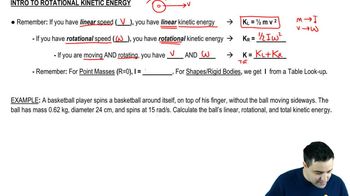
Kinetic energy is the energy possessed by an object due to its motion, calculated using the formula KE = 1/2 mv², where m is mass and v is velocity. In the context of proton-beam therapy, the kinetic energy of protons is crucial as it determines how much energy can be transferred to the tumor cells upon impact, leading to DNA damage and cell death.
Recommended video:
Guided course
06:07
Intro to Rotational Kinetic Energy

Electric Potential and Charge

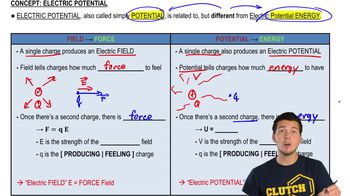
Electric potential, measured in volts (V), represents the potential energy per unit charge. When protons are accelerated through a potential difference, they gain kinetic energy equal to the charge multiplied by the potential difference (E = qV). This relationship is essential for calculating the total charge of protons needed to achieve a specific energy deposition in the tumor.
Recommended video:
Guided course
07:33
Electric Potential

Proton Therapy

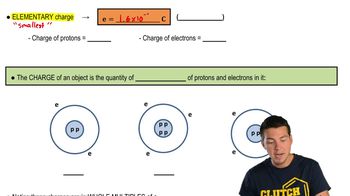
Proton therapy is a form of radiation treatment that uses protons to irradiate cancerous tissues. Unlike conventional X-ray therapy, protons can be precisely controlled to deposit their energy at a specific depth, minimizing damage to surrounding healthy tissues. Understanding the principles of proton therapy is vital for determining the appropriate energy and charge required for effective treatment.
Recommended video:
Guided course
05:37
Electric Charge