Ch 25: The Electric Potential
Knight Calc - Physics for Scientists and Engineers 5th Edition
Knight Calc5th EditionPhysics for Scientists and EngineersISBN: 9780137344796Not the one you use?Change textbook
Chapter 25, Problem 16a

An electron with an initial speed of 500,000 m/s is brought to rest by an electric field. Did the electron move into a region of higher potential or lower potential?

Verified step by step guidance
1
Understand the relationship between electric potential and the motion of a charged particle. An electron is negatively charged, so it moves toward higher potential when it slows down and comes to rest in an electric field.
Recall that the work done by the electric field on the electron is related to the change in its kinetic energy. The work-energy principle states: \( W = \Delta KE \), where \( W \) is the work done and \( \Delta KE \) is the change in kinetic energy.
The work done by the electric field is also related to the change in electric potential energy: \( W = -q \Delta V \), where \( q \) is the charge of the electron and \( \Delta V \) is the change in electric potential.
Combine the two equations: \( -q \Delta V = \Delta KE \). Since the electron is brought to rest, its final kinetic energy is zero, and \( \Delta KE = -\frac{1}{2} m v^2 \), where \( m \) is the mass of the electron and \( v \) is its initial speed.
Substitute \( \Delta KE \) into the equation: \( -q \Delta V = -\frac{1}{2} m v^2 \). Since \( q \) is negative for an electron, \( \Delta V \) must be positive, indicating that the electron moved into a region of higher potential.

Verified video answer for a similar problem:

This video solution was recommended by our tutors as helpful for the problem above.
Was this helpful?

Key Concepts

Here are the essential concepts you must grasp in order to answer the question correctly.

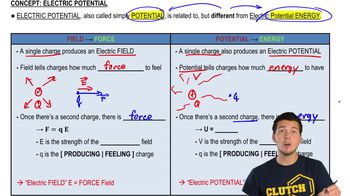
Electric Potential

Electric potential is the amount of electric potential energy per unit charge at a point in an electric field. It is measured in volts and indicates the work done to move a charge from a reference point to a specific point in the field. A higher electric potential means that a positive charge would gain energy, while a lower potential indicates that it would lose energy.
Recommended video:
Guided course
07:33
Electric Potential

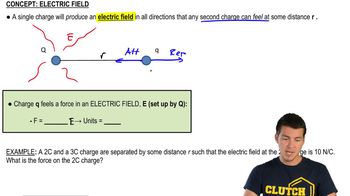
Electric Field

An electric field is a region around a charged object where other charged objects experience a force. The direction of the electric field is defined as the direction a positive test charge would move. When a charged particle, like an electron, moves in an electric field, it accelerates towards regions of higher potential if it is positively charged, and towards lower potential if negatively charged.
Recommended video:
Guided course
03:16
Intro to Electric Fields

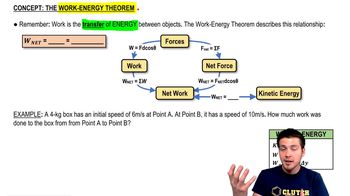
Kinetic Energy and Work-Energy Principle

Kinetic energy is the energy an object possesses due to its motion, calculated as 1/2 mv², where m is mass and v is velocity. The work-energy principle states that the work done on an object is equal to the change in its kinetic energy. In this scenario, as the electron is brought to rest, work is done on it by the electric field, indicating that it must have moved into a region of higher potential, losing kinetic energy.
Recommended video:
Guided course
04:10
The Work-Energy Theorem