
Textbook Question
CALC A uniform electric field’s strength is increasing with time as . A proton is released in the field from rest at t = 0. What is the proton’s speed 1.0 μs later?

 Verified step by step guidance
 03:16
03:16
 04:44
04:44 08:25
08:25CALC A uniform electric field’s strength is increasing with time as . A proton is released in the field from rest at t = 0. What is the proton’s speed 1.0 μs later?
Charge Q is uniformly distributed along a thin, flexible rod of length L. The rod is then bent into the semicircle shown in FIGURE P23.48. Find an expression for the electric field Ē at the center of the semicircle. Hint: A small piece of arc length Δs spans a small angle Δθ=Δs/R , where R is the radius.
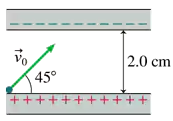
A problem of practical interest is to make a beam of electrons turn a 90° corner. This can be done with the parallel-plate capacitor shown in FIGURE P23.55. An electron with kinetic energy 3.0×10⁻¹⁷ J enters through a small hole in the bottom plate of the capacitor. Should the bottom plate be charged positive or negative relative to the top plate if you want the electron to turn to the right? Explain.
INT In a classical model of the hydrogen atom, the electron orbits the proton in a circular orbit of radius 0.053 nm. What is the orbital frequency in rev/s? The proton is so much more massive than the electron that you can assume the proton is at rest.
An infinite plane of charge with surface charge density 3.2 μC/m2 has a 20-cm-diameter circular hole cut out of it. What is the electric field strength directly over the center of the hole at a distance of 12 cm? Hint: Can you create this charge distribution as a superposition of charge distributions for which you know the electric field?
An electric field can induce an electric dipole in a neutral atom or molecule by pushing the positive and negative charges in opposite directions. The dipole moment of an induced dipole is directly proportional to the electric field. That is, , where α is called the polarizability of the molecule. A bigger field stretches the molecule farther and causes a larger dipole moment. An ion with charge q is distance r from a molecule with polarizability α. Find an expression for the force ion on dipole.