

The two parallel plates in FIGURE P23.53 are 2.0 cm apart and the electric field strength between them is 1.0×10⁴ N/C. An electron is launched at a 45° angle from the positive plate. What is the maximum initial speed v0 the electron can have without hitting the negative plate?
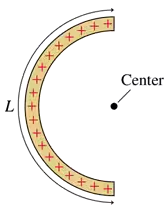
Charge Q is uniformly distributed along a thin, flexible rod of length L. The rod is then bent into the semicircle shown in FIGURE P23.48. Find an expression for the electric field Ē at the center of the semicircle. Hint: A small piece of arc length Δs spans a small angle Δθ=Δs/R , where R is the radius.

Verified step by step guidance
Verified video answer for a similar problem:
Key Concepts
Electric Field
Continuous Charge Distribution
Arc Length and Angle Relationship
CALC A uniform electric field’s strength is increasing with time as . A proton is released in the field from rest at t = 0. What is the proton’s speed 1.0 μs later?
Derive Equation 23.11 for the field Ē dipole in the plane that bisects an electric dipole.
FIGURE P23.44 shows a thin rod of length L with total charge Q. Evaluate E at r=3.0 cm if L=5.0 cm and Q=3.0 nC.
An infinite plane of charge with surface charge density 3.2 μC/m2 has a 20-cm-diameter circular hole cut out of it. What is the electric field strength directly over the center of the hole at a distance of 12 cm? Hint: Can you create this charge distribution as a superposition of charge distributions for which you know the electric field?
A ring of radius R has total charge Q. At what distance along the z-axis is the electric field strength a maximum?
