
Ch 22: Electric Charges and Forces
Knight Calc - Physics for Scientists and Engineers 5th Edition
Knight Calc5th EditionPhysics for Scientists and EngineersISBN: 9780137344796Not the one you use?Change textbook
Chapter 22, Problem 77

Space explorers discover an 8.7×10¹⁷ kg asteroid that happens to have a positive charge of 4400 C. They would like to place their 3.3×10⁵ kg spaceship in orbit around the asteroid. Interestingly, the solar wind has given their spaceship a charge of −1.2C. What speed must their spaceship have to achieve a 7500-km-diameter circular orbit?

Verified step by step guidance
1
Determine the radius of the circular orbit. Since the diameter of the orbit is given as 7500 km, the radius is half of the diameter: \( r = \frac{7500}{2} \times 10^3 \) meters.
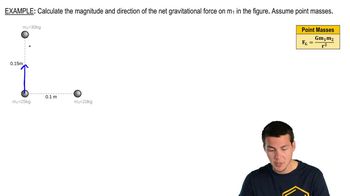
Calculate the gravitational force between the asteroid and the spaceship using Newton's law of gravitation: \( F_g = \frac{G m_1 m_2}{r^2} \), where \( G \) is the gravitational constant \( 6.674 \times 10^{-11} \, \text{N·m}^2/\text{kg}^2 \), \( m_1 \) is the mass of the asteroid, \( m_2 \) is the mass of the spaceship, and \( r \) is the radius of the orbit.
Calculate the electrostatic force between the asteroid and the spaceship using Coulomb's law: \( F_e = \frac{k |q_1 q_2|}{r^2} \), where \( k \) is Coulomb's constant \( 8.99 \times 10^9 \, \text{N·m}^2/\text{C}^2 \), \( q_1 \) is the charge of the asteroid, \( q_2 \) is the charge of the spaceship, and \( r \) is the radius of the orbit.
Determine the net centripetal force acting on the spaceship. Since the gravitational and electrostatic forces act in opposite directions (gravitational force is attractive, while electrostatic force is repulsive), the net force is \( F_{net} = F_g - F_e \).
Use the centripetal force equation to find the orbital speed of the spaceship: \( F_{net} = \frac{m_2 v^2}{r} \). Solve for \( v \): \( v = \sqrt{\frac{F_{net} r}{m_2}} \). Substitute the values of \( F_{net} \), \( r \), and \( m_2 \) to calculate the orbital speed.

Verified video answer for a similar problem:

This video solution was recommended by our tutors as helpful for the problem above.
Video duration:
9m
Was this helpful?

Key Concepts

Here are the essential concepts you must grasp in order to answer the question correctly.

Gravitational Force

The gravitational force is the attractive force between two masses, described by Newton's law of universal gravitation. It states that the force is proportional to the product of the masses and inversely proportional to the square of the distance between their centers. This force is crucial for understanding how objects like spaceships can orbit larger bodies like asteroids.
Recommended video:
Guided course
05:41
Gravitational Forces in 2D

Coulomb's Law

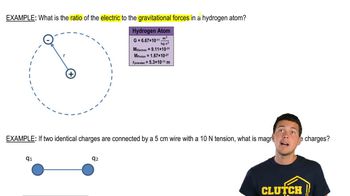
Coulomb's Law describes the electrostatic interaction between charged particles. It states that the force between two charges is directly proportional to the product of the magnitudes of the charges and inversely proportional to the square of the distance between them. In this scenario, the positive charge of the asteroid and the negative charge of the spaceship will influence the forces acting on the spaceship, affecting its orbital dynamics.
Recommended video:
Guided course
09:52
Coulomb's Law

Orbital Velocity

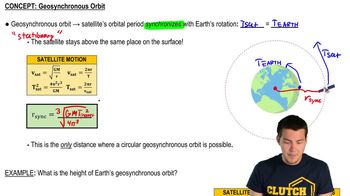
Orbital velocity is the speed required for an object to maintain a stable orbit around a celestial body. It depends on the mass of the body being orbited and the radius of the orbit. For a circular orbit, the gravitational force must equal the centripetal force required to keep the spaceship in motion, allowing us to calculate the necessary speed for the spaceship to achieve a 7500-km-diameter orbit around the asteroid.
Recommended video:
Guided course
04:45
Geosynchronous Orbits