
In Section 22.3 we claimed that a charged object exerts a net attractive force on an electric dipole. Let's investigate this. FIGURE CP22.80 shows a permanent electric dipole consisting of charges +q and −q separated by the fixed distance s. Charge +Q is distance r from the center of the dipole. We'll assume, as is usually the case in practice, that s≪r. Use the binomial approximation if x≪1 to show that your expression from part a can be written .
Ch 22: Electric Charges and Forces
Knight Calc5th EditionPhysics for Scientists and EngineersISBN: 9780137344796Not the one you use?Change textbook
Chapter 22, Problem 78
A small 1.0 g block charged to 75 nC is placed on a 30° inclined plane. The coefficients of static and kinetic friction are 0.20 and 0.10, respectively. What minimum strength horizontal electric field is needed to keep the block from sliding down the plane?
Verified step by step guidance1
Step 1: Begin by analyzing the forces acting on the block. The forces include gravity, friction, and the electric force due to the horizontal electric field. Break the gravitational force into components parallel and perpendicular to the inclined plane. The parallel component is given by \( F_{g, \text{parallel}} = m g \sin \theta \), and the perpendicular component is \( F_{g, \text{perpendicular}} = m g \cos \theta \).
Step 2: Calculate the maximum static friction force that can act on the block. The static friction force is \( F_{\text{friction}} = \mu_s F_{g, \text{perpendicular}} \), where \( \mu_s \) is the coefficient of static friction and \( F_{g, \text{perpendicular}} \) is the normal force exerted by the inclined plane.
Step 3: Determine the electric force required to counteract the net force pulling the block down the incline. The electric force is given by \( F_{\text{electric}} = q E \), where \( q \) is the charge on the block and \( E \) is the strength of the electric field. This force must be equal to or greater than the sum of \( F_{g, \text{parallel}} \) and \( F_{\text{friction}} \) to prevent the block from sliding.
Step 4: Set up the equation for equilibrium along the incline: \( F_{\text{electric}} = F_{g, \text{parallel}} - F_{\text{friction}} \). Substitute the expressions for \( F_{g, \text{parallel}} \), \( F_{\text{friction}} \), and \( F_{\text{electric}} \) into the equation.
Step 5: Solve for the minimum electric field strength \( E \) by rearranging the equation: \( E = \frac{F_{g, \text{parallel}} - F_{\text{friction}}}{q} \). Substitute the given values for mass \( m \), charge \( q \), angle \( \theta \), gravitational acceleration \( g \), and the coefficient of static friction \( \mu_s \) to find the required electric field strength.

Verified video answer for a similar problem:
This video solution was recommended by our tutors as helpful for the problem above.
Video duration:
11mWas this helpful?
Key Concepts
Here are the essential concepts you must grasp in order to answer the question correctly.
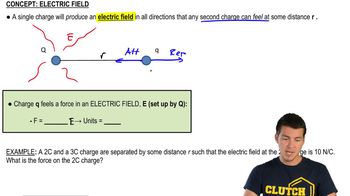
Electric Field
An electric field is a region around a charged particle where other charged particles experience a force. The strength of the electric field (E) is defined as the force (F) per unit charge (q), expressed as E = F/q. In this scenario, the electric field will exert a force on the charged block, counteracting the gravitational component pulling it down the incline.
Recommended video:
Guided course
Intro to Electric Fields
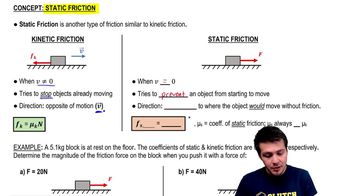
Friction
Friction is the resistive force that opposes the motion of an object in contact with a surface. It is characterized by two coefficients: static friction (which prevents motion) and kinetic friction (which acts during motion). The static friction coefficient (0.20) will determine the maximum force that can be exerted before the block begins to slide down the incline, while the kinetic friction coefficient (0.10) applies once the block is in motion.
Recommended video:
Guided course
Static Friction & Equilibrium
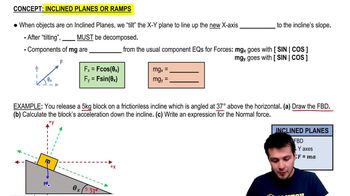
Inclined Plane Dynamics
When an object is placed on an inclined plane, the forces acting on it include gravitational force, normal force, and friction. The gravitational force can be resolved into two components: one parallel to the incline (causing the block to slide down) and one perpendicular to the incline (balanced by the normal force). Understanding these forces is crucial for calculating the net force acting on the block and determining the required electric field strength to prevent sliding.
Recommended video:
Guided course
Intro to Inclined Planes
Related Practice
Textbook Question
1
views
Textbook Question
Space explorers discover an 8.7×10¹⁷ kg asteroid that happens to have a positive charge of 4400 C. They would like to place their 3.3×10⁵ kg spaceship in orbit around the asteroid. Interestingly, the solar wind has given their spaceship a charge of −1.2C. What speed must their spaceship have to achieve a 7500-km-diameter circular orbit?
Textbook Question
A 5.0 g ball charged to 1.5 μC is tied to a 25-cm-long string. It swings at 250 rpm in a horizontal circle around a stationary ball charged to −2.5 μC. What is the tension in the string?
Textbook Question
Starting from rest, how long does it take an electron to move 1.0 cm in a steady electric field of magnitude 100 N/C?
1
views
