Ch 21: Heat Engines and Refrigerators
Knight Calc - Physics for Scientists and Engineers 5th Edition
Knight Calc5th EditionPhysics for Scientists and EngineersISBN: 9780137344796Not the one you use?Change textbook
Chapter 21, Problem 62b

The heat engine shown in FIGURE P21.62 uses 2.0 mol of a monatomic gas as the working substance. Make a table that shows ∆Eth, Ws, and Q for each of the three processes.

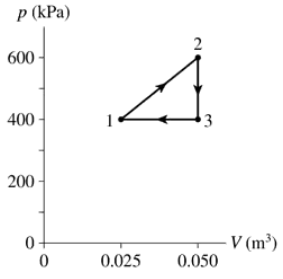
Verified step by step guidance
1
Step 1: Understand the problem. The heat engine operates with 2.0 mol of a monatomic gas, and we need to calculate the change in internal energy (∆Eₜₕ), work done (Wₛ), and heat transfer (Q) for each of the three processes. Recall that for a monatomic gas, the internal energy is related to temperature through the formula: E=32nRT, where n is the number of moles, R is the gas constant, and T is the temperature.
Step 2: Identify the type of processes involved. Heat engines typically involve processes such as isothermal (constant temperature), adiabatic (no heat transfer), or isochoric (constant volume). For each process, use the appropriate thermodynamic relationships to calculate ∆Eₜₕ, Wₛ, and Q. For example: Q=W for isothermal processes, and ∆Eₜₕ=Q-W for general processes.
Step 3: Use the first law of thermodynamics, ∆Eₜₕ=Q-W, to calculate the change in internal energy for each process. For a monatomic gas, the change in internal energy depends only on the change in temperature. If the temperature remains constant (isothermal process), then ∆Eₜₕ=0. For adiabatic processes, Q=0, and the work done is equal to the change in internal energy.
Step 4: Calculate the work done (Wₛ) for each process. For isothermal processes, use the formula: W=nRTln(VfVi), where Vₓ represents the initial and final volumes. For adiabatic processes, use the relationship between pressure, volume, and temperature for adiabatic expansion/compression.
Step 5: Summarize the results in a table format. For each process, list the values of ∆Eₜₕ, Wₛ, and Q based on the calculations performed in the previous steps. Ensure that the values are consistent with the type of process (isothermal, adiabatic, or isochoric) and the given conditions of the heat engine.

Verified video answer for a similar problem:

This video solution was recommended by our tutors as helpful for the problem above.
Was this helpful?

Key Concepts

Here are the essential concepts you must grasp in order to answer the question correctly.

First Law of Thermodynamics

The First Law of Thermodynamics states that energy cannot be created or destroyed, only transformed from one form to another. In the context of a heat engine, this principle is crucial for understanding how heat energy (Q) is converted into work (W) and how internal energy (∆E) changes during the engine's cycles.
Recommended video:
Guided course
08:04
The First Law of Thermodynamics

Monatomic Gas Properties

Monatomic gases, such as helium or argon, consist of single atoms and exhibit specific thermodynamic behaviors. Their internal energy is directly related to temperature and can be calculated using the formula U = (3/2)nRT, where n is the number of moles, R is the gas constant, and T is the temperature in Kelvin. Understanding these properties is essential for analyzing the energy changes in the heat engine.
Recommended video:
Guided course
08:45
Properties of Cyclic Thermodynamic Processes

Thermodynamic Processes

Thermodynamic processes describe the changes in state variables of a system, such as pressure, volume, and temperature, during energy transfer. In a heat engine, these processes can be isothermal, adiabatic, isochoric, or isobaric, each affecting the work done (W) and heat exchanged (Q) differently. A clear understanding of these processes is necessary to construct the required table of energy changes.
Recommended video:
Guided course
08:45
Properties of Cyclic Thermodynamic Processes