Ch 21: Heat Engines and Refrigerators
Knight Calc - Physics for Scientists and Engineers 5th Edition
Knight Calc5th EditionPhysics for Scientists and EngineersISBN: 9780137344796Not the one you use?Change textbook
Chapter 21, Problem 57a

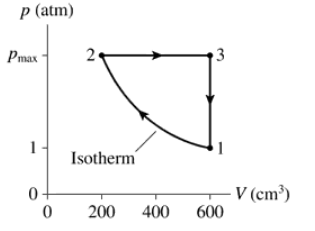
FIGURE P21.57 shows the cycle for a heat engine that uses a gas having γ = 1.25. The initial temperature is T1 = 300 K, and this engine operates at 20 cycles per second. What is the power output of the engine?

Verified step by step guidance
1
Step 1: Understand the problem and identify the key variables. The heat engine operates in a cycle with a gas having a specific heat ratio (r = 1.25). The initial temperature is T₁ = 300 K, and the engine runs at 20 cycles per second. The goal is to calculate the power output of the engine, which is the work done per cycle multiplied by the number of cycles per second.
Step 2: Analyze the thermodynamic cycle shown in FIGURE P21.57. Typically, such cycles involve processes like isothermal expansion, adiabatic compression, and isochoric heating or cooling. Use the specific heat ratio (r) and the ideal gas law to determine the work done during each process in the cycle.
Step 3: Calculate the net work done per cycle. For each segment of the cycle, use the appropriate thermodynamic equations. For example, for an isothermal process, the work done can be calculated using \( W = nRT \ln \left( \frac{V_f}{V_i} \right) \), and for an adiabatic process, use \( W = \frac{P_i V_i - P_f V_f}{r - 1} \). Sum the work contributions from all processes to find the net work per cycle.
Step 4: Determine the energy transferred as heat during the cycle. Use the first law of thermodynamics \( \Delta U = Q - W \) to relate the heat transfer, work done, and change in internal energy for each process. Ensure that the net heat transfer matches the net work output, as required by the conservation of energy.
Step 5: Calculate the power output of the engine. Power is defined as the work done per unit time. Multiply the net work per cycle by the number of cycles per second (20 cycles per second) to find the power output. Express the result in watts (joules per second).

Verified video answer for a similar problem:

This video solution was recommended by our tutors as helpful for the problem above.
Video duration:
10m
Was this helpful?

Key Concepts

Here are the essential concepts you must grasp in order to answer the question correctly.

Heat Engine

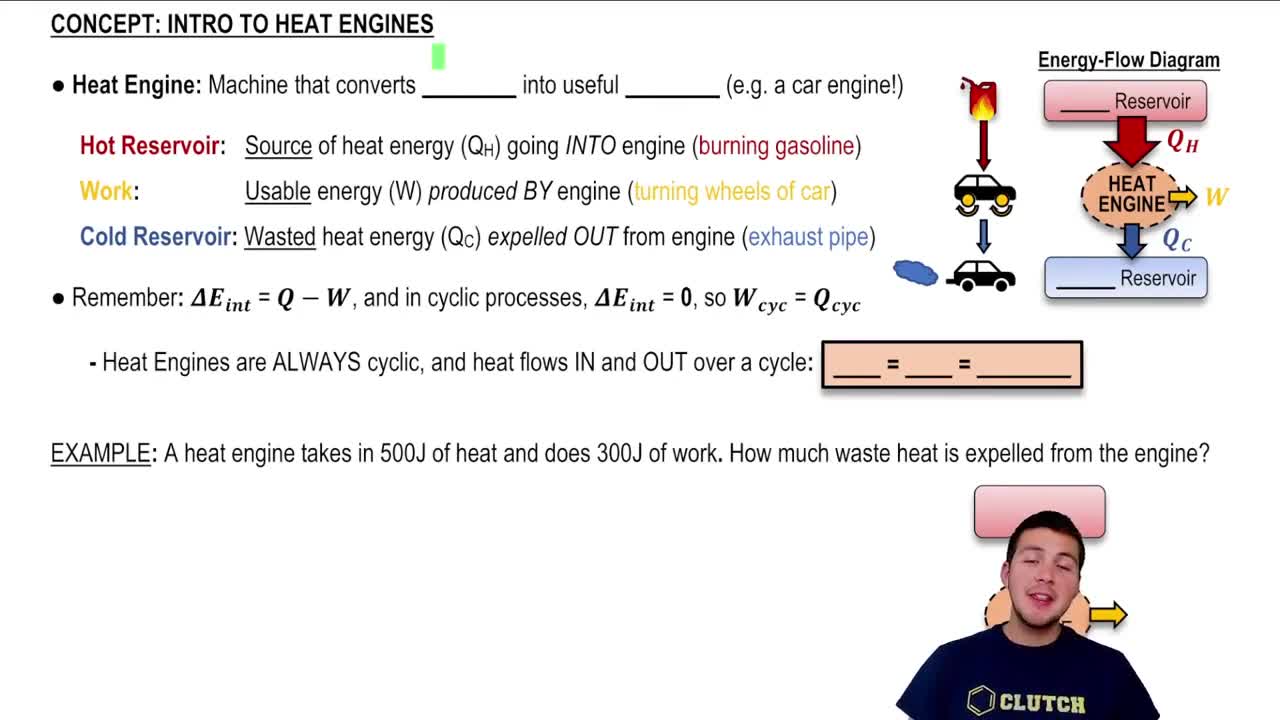
A heat engine is a device that converts thermal energy into mechanical work by exploiting the temperature difference between a hot reservoir and a cold reservoir. It operates on a cyclic process, absorbing heat from the hot reservoir, performing work, and releasing some heat to the cold reservoir. The efficiency of a heat engine is determined by the temperatures of these reservoirs and the specific cycle it follows.
Recommended video:
Guided course
07:35
Introduction to Heat Engines

Thermal Efficiency

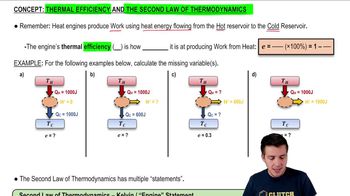
Thermal efficiency is a measure of how effectively a heat engine converts heat into work. It is defined as the ratio of the work output to the heat input from the hot reservoir. For an ideal gas, the efficiency can be influenced by the specific heat ratio (r) and the temperatures involved, following the relation: efficiency = 1 - (T_cold/T_hot).
Recommended video:
Guided course
06:01
Thermal Efficiency & The Second Law of Thermodynamics

Power Output

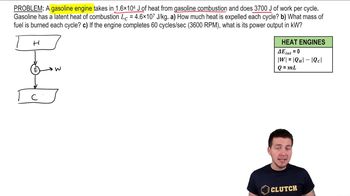
Power output refers to the rate at which work is done by the engine, typically measured in watts (W). It can be calculated by multiplying the work done per cycle by the number of cycles per second. In the context of a heat engine, the power output is directly related to the efficiency and the amount of heat absorbed from the hot reservoir during each cycle.
Recommended video:
Guided course
06:58
Power Output of a Gasoline Engine
Related Practice
Textbook Question

A heat engine uses a diatomic gas that follows the pV cycle in FIGURE P21.59. Determine the pressure, volume, and temperature at point 2.

2
views

Textbook Question

A typical coal-fired power plant burns 300 metric tons of coal every hour to generate 750 MW of electricity. 1 metric ton = 1000 kg. The density of coal is 1500 kg/m³ and its heat of combustion is 28 MJ/kg. Assume that all heat is transferred from the fuel to the boiler and that all the work done in spinning the turbine is transformed into electric energy. Suppose the coal is piled up in a 10 m ✕ 10 m room. How tall must the pile be to operate the plant for one day?

2
views
Textbook Question

A nuclear power plant generates 3000 MW of heat energy from nuclear reactions in the reactor's core. This energy is used to boil water and produce high-pressure steam at 300℃. The steam spins a turbine, which produces 1000 MW of electric power, then the steam is condensed and the water is cooled to 25℃ before starting the cycle again. What is the plant's actual efficiency?

1
views
Textbook Question

The heat engine shown in FIGURE P21.62 uses 2.0 mol of a monatomic gas as the working substance. Determine T1, T2 and T3.

1
views
Textbook Question

A heat engine using a diatomic gas follows the cycle shown in FIGURE P21.55. Its temperature at point 1 is 20℃. Determine Ws, Q, and ∆Eth for each of the three processes in this cycle. Display your results in a table.

1
views
Textbook Question

The heat engine shown in FIGURE P21.62 uses 2.0 mol of a monatomic gas as the working substance. Make a table that shows ∆Eth, Ws, and Q for each of the three processes.

3
views