
Ch 21: Heat Engines and Refrigerators
Knight Calc - Physics for Scientists and Engineers 5th Edition
Knight Calc5th EditionPhysics for Scientists and EngineersISBN: 9780137344796Not the one you use?Change textbook
Chapter 21, Problem 73a

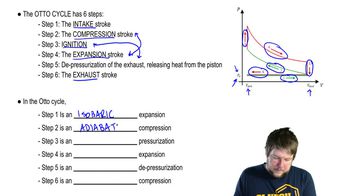
The gasoline engine in your car can be modeled as the Otto cycle shown in FIGURE CP21.73. A fuel-air mixture is sprayed into the cylinder at point 1, where the piston is at its farthest distance from the spark plug. This mixture is compressed as the piston moves toward the spark plug during the adiabatic compression stroke. The spark plug fires at point 2, releasing heat energy that had been stored in the gasoline. The fuel burns so quickly that the piston doesn't have time to move, so the heating is an isochoric process. The hot, high-pressure gas then pushes the piston outward during the power stroke. Finally, an exhaust value opens to allow the gas temperature and pressure to drop back to their initial values before starting the cycle over again. Analyze the Otto cycle and show that the work done per cycle is Wout=nR1γ(T2T1+T4T3)W_{\(\text{out}\)} = \(\frac{nR}{1-\gamma}\)(T_2 - T_1 + T_4 - T_3)

Verified step by step guidance
1
Step 1: Understand the Otto cycle. The Otto cycle consists of four processes: (1) adiabatic compression, (2) isochoric heating, (3) adiabatic expansion, and (4) isochoric cooling. The work done per cycle is the net work done during the adiabatic processes, which can be calculated using the first law of thermodynamics.
Step 2: Write the expression for the work done in the cycle. The work done per cycle is the difference between the work done during the adiabatic expansion (process 3) and the work done during the adiabatic compression (process 1). Mathematically, \( W_{cycle} = W_{expansion} - W_{compression} \).
Step 3: Use the thermodynamic relationships for adiabatic processes. For an adiabatic process, the work done can be expressed as \( W = \frac{P_2 V_2 - P_1 V_1}{\gamma - 1} \), where \( \gamma \) is the adiabatic index (ratio of specific heats), \( P \) is pressure, and \( V \) is volume. Apply this formula to both the compression and expansion processes.
Step 4: Relate the heat added during the isochoric heating process to the change in internal energy. For an isochoric process, the heat added is \( Q = n C_v \Delta T \), where \( n \) is the number of moles, \( C_v \) is the specific heat at constant volume, and \( \Delta T \) is the temperature change. This heat contributes to the energy available for the adiabatic expansion.
Step 5: Combine the results to express the net work done per cycle. Substitute the expressions for \( W_{expansion} \), \( W_{compression} \), and the heat added during the isochoric process into the equation for \( W_{cycle} \). Simplify the terms to show the relationship between the work done per cycle and the thermodynamic properties of the Otto cycle.

Verified video answer for a similar problem:

This video solution was recommended by our tutors as helpful for the problem above.
Video duration:
12m
Was this helpful?

Key Concepts

Here are the essential concepts you must grasp in order to answer the question correctly.

Otto Cycle

The Otto cycle is a thermodynamic cycle that describes the functioning of a gasoline engine. It consists of four main processes: adiabatic compression, isochoric heat addition, adiabatic expansion, and isochoric heat rejection. This cycle illustrates how the engine converts fuel into mechanical work by compressing a fuel-air mixture, igniting it, and allowing the resulting gas expansion to drive the piston.
Recommended video:
Guided course
10:59
The Otto Cycle

Adiabatic Process

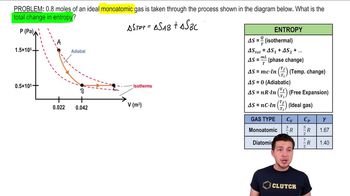
An adiabatic process is one in which no heat is exchanged with the surroundings. In the context of the Otto cycle, both the compression and expansion strokes are adiabatic, meaning that the gas temperature changes due to work done on or by the gas, rather than heat transfer. This principle is crucial for understanding how the engine efficiently converts thermal energy into mechanical work.
Recommended video:
Guided course
06:13
Entropy & Ideal Gas Processes

Isochoric Process

An isochoric process occurs at constant volume, meaning that the gas does not expand or contract during the process. In the Otto cycle, the heat addition from the spark plug happens during the isochoric phase, where the volume of the gas remains fixed while its temperature and pressure increase. This process is essential for understanding how energy is stored in the gas before it expands and does work on the piston.
Recommended video:
Guided course
08:45
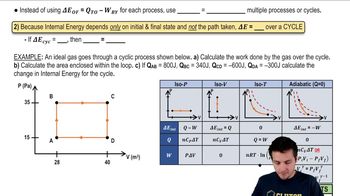
Properties of Cyclic Thermodynamic Processes