Ch 21: Heat Engines and Refrigerators
Knight Calc - Physics for Scientists and Engineers 5th Edition
Knight Calc5th EditionPhysics for Scientists and EngineersISBN: 9780137344796Not the one you use?Change textbook
Chapter 21, Problem 1

A heat engine does 200 J of work per cycle while exhausting 400 J of waste heat. What is the engine's thermal efficiency?

Verified step by step guidance
1
Step 1: Understand the concept of thermal efficiency. Thermal efficiency (η) is a measure of how well a heat engine converts heat energy into useful work. It is defined as the ratio of the work output (W) to the heat input (Q_in): η = W / Q_in.
Step 2: Identify the given values in the problem. The work done by the engine per cycle (W) is 200 J, and the waste heat exhausted (Q_out) is 400 J. The heat input (Q_in) can be calculated using the relationship Q_in = W + Q_out.
Step 3: Calculate the heat input (Q_in). Substitute the given values into the equation Q_in = W + Q_out. This will give you the total heat energy supplied to the engine.
Step 4: Substitute the values of work (W) and heat input (Q_in) into the formula for thermal efficiency: η = W / Q_in. This will allow you to determine the efficiency of the engine.
Step 5: Express the thermal efficiency as a percentage. Multiply the result of η by 100 to convert it into a percentage form, which is a more common way to express efficiency.

Verified video answer for a similar problem:

This video solution was recommended by our tutors as helpful for the problem above.
Video duration:
1m
Was this helpful?

Key Concepts

Here are the essential concepts you must grasp in order to answer the question correctly.

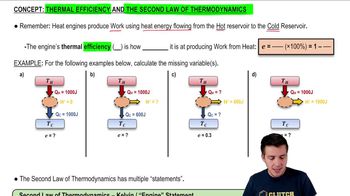
Thermal Efficiency

Thermal efficiency is a measure of how effectively a heat engine converts heat energy into work. It is defined as the ratio of the work output to the heat input, expressed as a percentage. A higher thermal efficiency indicates a more effective engine, as it means less energy is wasted as heat.
Recommended video:
Guided course
06:01
Thermal Efficiency & The Second Law of Thermodynamics

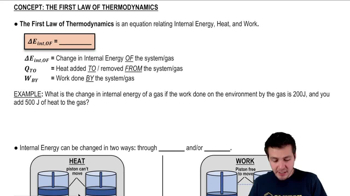
First Law of Thermodynamics

The First Law of Thermodynamics states that energy cannot be created or destroyed, only transformed from one form to another. In the context of a heat engine, this principle implies that the total energy input (heat) must equal the sum of the work done and the waste heat expelled. This law is fundamental in analyzing energy transfers in thermodynamic systems.
Recommended video:
Guided course
08:04
The First Law of Thermodynamics

Heat Input and Waste Heat

In a heat engine, heat input refers to the total thermal energy supplied to the engine, while waste heat is the energy that is not converted into work and is expelled into the environment. Understanding these two quantities is crucial for calculating thermal efficiency, as they directly influence the performance and effectiveness of the engine.
Recommended video:
Guided course
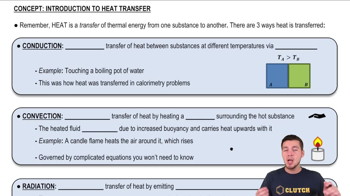
05:14
Overview of Heat Transfer