
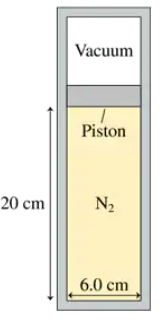
A 6.0-cm-diameter cylinder of nitrogen gas has a 4.0-cm-thick movable copper piston. The cylinder is oriented vertically, as shown in FIGURE P19.49, and the air above the piston is evacuated. When the gas temperature is 20°C, the piston floats 20 cm above the bottom of the cylinder. What is the gas pressure?
Knight Calc 5th Edition
Ch 19: Work, Heat, and the First Law of Thermodynamics
Problem 49cA 6.0-cm-diameter cylinder of nitrogen gas has a 4.0-cm-thick movable copper piston. The cylinder is oriented vertically, as shown in FIGURE P19.49, and the air above the piston is evacuated. When the gas temperature is 20°C, the piston floats 20 cm above the bottom of the cylinder. What is the new equilibrium temperature of the gas?

Verified step by step guidance
Verified video answer for a similar problem:
Key Concepts
Ideal Gas Law
Thermal Equilibrium
Charles's Law
2.0 mol of gas are at 30 °C and a pressure of 1.5 atm. How much work must be done on the gas to compress it to one third of its initial volume at constant pressure?
An ideal-gas process is described by p=cV1/2, where c is a constant. Find an expression for the work done on the gas in this process as the volume changes from V1 to V2.
0.25 mol of a gas are compressed at a constant pressure of 250 kPa from 6000 cm3 to 2000 cm3, then expanded at a constant temperature back to 6000 cm3. What is the net work done on the gas?
The beaker in FIGURE P19.45, with a thin metal bottom, is filled with 20 g of water at 20°C. It is brought into good thermal contact with a 4000 cm3 container holding 0.40 mol of a monatomic gas at 10 atm pressure. Both containers are well insulated from their surroundings. What is the gas pressure after a long time has elapsed? You can assume that the containers themselves are nearly massless and do not affect the outcome.
A typical nuclear reactor generates 1000 MW (1000 MJ/s) of electric energy. In doing so, it produces 2000 MW of 'waste heat' that must be removed from the reactor to keep it from melting down. Many reactors are sited next to large bodies of water so that they can use the water for cooling. Consider a reactor where the intake water is at 18°C. State regulations limit the temperature of the output water to 30°C so as not to harm aquatic organisms. How many liters of cooling water have to be pumped through the reactor each minute?