Ch 19: Work, Heat, and the First Law of Thermodynamics
Knight Calc - Physics for Scientists and Engineers 5th Edition
Knight Calc5th EditionPhysics for Scientists and EngineersISBN: 9780137344796Not the one you use?Change textbook
Chapter 19, Problem 49a

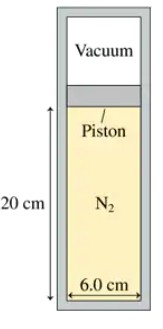
A 6.0-cm-diameter cylinder of nitrogen gas has a 4.0-cm-thick movable copper piston. The cylinder is oriented vertically, as shown in FIGURE P19.49, and the air above the piston is evacuated. When the gas temperature is 20°C, the piston floats 20 cm above the bottom of the cylinder. What is the gas pressure?

Verified step by step guidance
1
Determine the area of the piston. The piston is circular, so its area can be calculated using the formula for the area of a circle: A=πr22, where r is the radius of the piston. The diameter of the piston is 6.0 cm, so the radius is half of that: r=3.0cm.
Calculate the weight of the copper piston. The weight is given by W=mg, where m is the mass of the piston and g is the acceleration due to gravity (approximately 9.8m/s22). To find the mass, use the density of copper (8.96g/cm33) and the volume of the piston. The volume of the piston is the area of its base multiplied by its thickness: V=Ah, where h is the thickness (4.0 cm).
Relate the gas pressure to the weight of the piston. Since the air above the piston is evacuated, the gas pressure inside the cylinder is the only force supporting the piston. The pressure is given by P=F/A, where F is the force exerted by the piston (equal to its weight) and A is the area of the piston.
Substitute the values for the weight of the piston and the area of the piston into the pressure formula. Ensure that all units are consistent (e.g., convert cm to m if necessary).
Simplify the expression to find the gas pressure. The result will be in Pascals (Pa), which is the SI unit for pressure.

Verified video answer for a similar problem:

This video solution was recommended by our tutors as helpful for the problem above.
Was this helpful?

Key Concepts

Here are the essential concepts you must grasp in order to answer the question correctly.

Gas Pressure

Gas pressure is defined as the force exerted by gas molecules colliding with the walls of a container per unit area. It is influenced by the number of gas molecules, their temperature, and the volume of the container. In this scenario, the pressure of the nitrogen gas can be calculated using the ideal gas law or by considering the weight of the piston and the area it covers.
Recommended video:
Guided course
17:04
Pressure and Atmospheric Pressure

Ideal Gas Law

The ideal gas law is a fundamental equation in thermodynamics that relates the pressure, volume, temperature, and number of moles of a gas. It is expressed as PV = nRT, where P is pressure, V is volume, n is the number of moles, R is the ideal gas constant, and T is temperature in Kelvin. This law helps in calculating the state of a gas under various conditions, such as the one described in the question.
Recommended video:
Guided course
07:21
Ideal Gases and the Ideal Gas Law

Hydrostatic Pressure

Hydrostatic pressure refers to the pressure exerted by a fluid at equilibrium due to the force of gravity. In this case, the weight of the copper piston creates a downward force that must be balanced by the pressure of the nitrogen gas inside the cylinder. The relationship between the weight of the piston and the area of the cylinder's base is crucial for determining the gas pressure.
Recommended video:
Guided course
17:04
Pressure and Atmospheric Pressure
Related Practice
Textbook Question

2.0 mol of gas are at 30 °C and a pressure of 1.5 atm. How much work must be done on the gas to compress it to one third of its initial volume at constant pressure?

1
views

Textbook Question

512 g of an unknown metal at a temperature of 15°C is dropped into a 100 g aluminum container holding 325 g of water at 98°C. A short time later, the container of water and metal stabilizes at a new temperature of 78°C. Identify the metal.

1
views
Textbook Question

0.25 mol of a gas are compressed at a constant pressure of 250 kPa from 6000 cm3 to 2000 cm3, then expanded at a constant temperature back to 6000 cm3. What is the net work done on the gas?

1
views
Textbook Question

The beaker in FIGURE P19.45, with a thin metal bottom, is filled with 20 g of water at 20°C. It is brought into good thermal contact with a 4000 cm3 container holding 0.40 mol of a monatomic gas at 10 atm pressure. Both containers are well insulated from their surroundings. What is the gas pressure after a long time has elapsed? You can assume that the containers themselves are nearly massless and do not affect the outcome.

2
views
Textbook Question

A 6.0-cm-diameter cylinder of nitrogen gas has a 4.0-cm-thick movable copper piston. The cylinder is oriented vertically, as shown in FIGURE P19.49, and the air above the piston is evacuated. When the gas temperature is 20°C, the piston floats 20 cm above the bottom of the cylinder. What is the new equilibrium temperature of the gas?

1
views
Textbook Question

A typical nuclear reactor generates 1000 MW (1000 MJ/s) of electric energy. In doing so, it produces 2000 MW of 'waste heat' that must be removed from the reactor to keep it from melting down. Many reactors are sited next to large bodies of water so that they can use the water for cooling. Consider a reactor where the intake water is at 18°C. State regulations limit the temperature of the output water to 30°C so as not to harm aquatic organisms. How many liters of cooling water have to be pumped through the reactor each minute?

1
views