
Ch 18: A Macroscopic Description of Matter
Knight Calc - Physics for Scientists and Engineers 5th Edition
Knight Calc5th EditionPhysics for Scientists and EngineersISBN: 9780137344796Not the one you use?Change textbook
Chapter 18, Problem 47

On average, each person in the industrialized world is responsible for the emission of 10,000 kg of carbon dioxide (CO₂) every year. This includes CO₂ that you generate directly, by burning fossil fuels to operate your car or your furnace, as well as CO₂ generated on your behalf by electric generating stations and manufacturing plants. CO₂ is a greenhouse gas that contributes to global warming. If you were to store your yearly CO₂ emissions in a cube at STP, how long would each edge of the cube be?

Verified step by step guidance
1
Step 1: Start by recalling the ideal gas law, which is given by the equation: PV=nRT. Here, P is the pressure, V is the volume, n is the number of moles, R is the ideal gas constant, and T is the temperature. At standard temperature and pressure (STP), P is 1 atm, T is 273.15 K, and R is 0.0821 L·atm/(mol·K).
Step 2: Calculate the number of moles of CO₂ emitted in a year. Use the molar mass of CO₂, which is approximately 44 g/mol. Convert the yearly emission of 10,000 kg of CO₂ to grams (1 kg = 1000 g), and then divide by the molar mass to find the number of moles: n = 10,000×100044.
Step 3: Rearrange the ideal gas law to solve for the volume V: V = nRTP. Substitute the values for n (calculated in Step 2), R = 0.0821 L·atm/(mol·K), T = 273.15 K, and P = 1 atm.
Step 4: Once the volume V is determined, recall that the volume of a cube is given by V = s^3, where s is the length of one edge of the cube. Solve for s by taking the cube root of the volume: s = V13.
Step 5: Substitute the calculated volume from Step 3 into the cube root formula to find the edge length of the cube. Ensure the units are consistent (e.g., convert the volume to cubic meters if necessary) to express the edge length in meters.

Verified video answer for a similar problem:

This video solution was recommended by our tutors as helpful for the problem above.
Video duration:
6m
Was this helpful?

Key Concepts

Here are the essential concepts you must grasp in order to answer the question correctly.

Greenhouse Gases

Greenhouse gases, such as carbon dioxide (CO₂), trap heat in the Earth's atmosphere, leading to the greenhouse effect. This process is essential for maintaining the planet's temperature but excessive emissions from human activities enhance this effect, contributing to global warming and climate change.
Recommended video:
Guided course
06:12
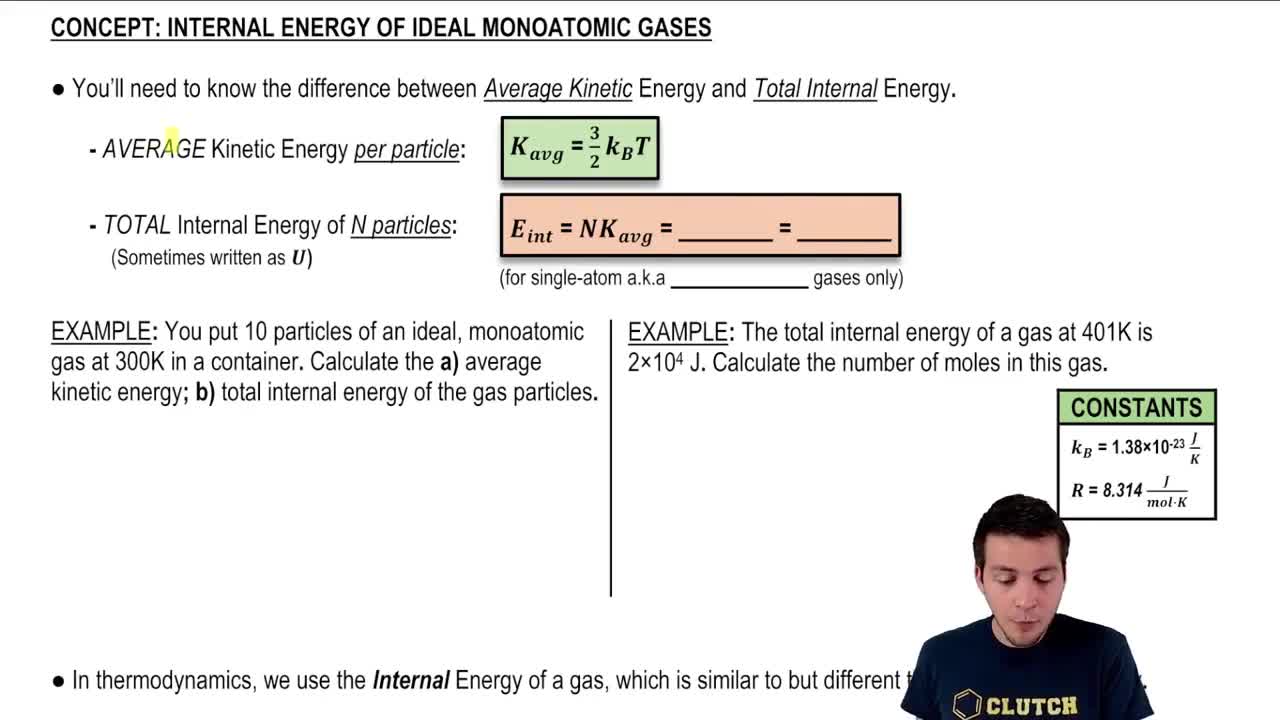
Internal Energy of Ideal Monoatomic Gases

Standard Temperature and Pressure (STP)

Standard Temperature and Pressure (STP) is a reference point used in chemistry and physics, defined as 0 degrees Celsius (273.15 K) and 1 atmosphere of pressure. At STP, one mole of an ideal gas occupies 22.4 liters, which is crucial for calculating the volume of gases and understanding how to convert mass of CO₂ emissions into a physical volume.
Recommended video:
Guided course
17:04
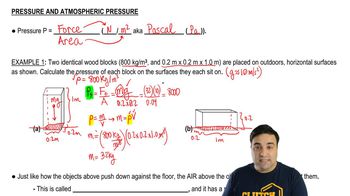
Pressure and Atmospheric Pressure

Volume of a Cube

The volume of a cube is calculated using the formula V = s³, where 's' is the length of one edge. To find the length of each edge when given the total volume, one can rearrange the formula to s = V^(1/3). This concept is essential for determining the dimensions of the cube that would contain the total CO₂ emissions.
Recommended video:
Guided course
05:21
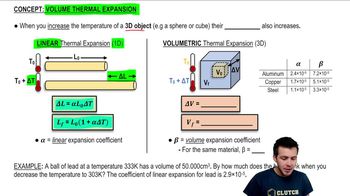
Volume Thermal Expansion
Related Practice
Textbook Question

A 6.0-cm-diameter, 10-cm-long cylinder contains 100 mg of oxygen (O₂) at a pressure less than 1 atm. The cap on one end of the cylinder is held in place only by the pressure of the air. One day when the atmospheric pressure is 100 kPa, it takes a 184 N force to pull the cap off. What is the temperature of the gas?

1
views
Textbook Question

The 3.0-m-long pipe in FIGURE P18.49 is closed at the top end. It is slowly pushed straight down into the water until the top end of the pipe is level with the water's surface. What is the length L of the trapped volume of air?

2
views
Textbook Question

The semiconductor industry manufactures integrated circuits in large vacuum chambers where the pressure is 1.0×10⁻¹⁰ mm of Hg. At T=20°C, how many molecules are in a cylindrical chamber 40 cm in diameter and 30 cm tall?

1
views
Textbook Question

A diving bell is a 3.0-m-tall cylinder closed at the upper end but open at the lower end. The temperature of the air in the bell is 20°C. The bell is lowered into the ocean until its lower end is 100 m deep. The temperature at that depth is 10°C. How high does the water rise in the bell after enough time has passed for the air inside to reach thermal equilibrium?

1
views
Textbook Question

An electric generating plant boils water to produce high-pressure steam. The steam spins a turbine that is connected to the generator. How many liters of water must be boiled to fill a 5.0 m3 boiler with 50 atm of steam at 400°C?

1
views
Textbook Question

The semiconductor industry manufactures integrated circuits in large vacuum chambers where the pressure is 1.0×10⁻¹⁰ mm of Hg. What fraction is this of atmospheric pressure?

1
views