Ch 18: A Macroscopic Description of Matter
Knight Calc - Physics for Scientists and Engineers 5th Edition
Knight Calc5th EditionPhysics for Scientists and EngineersISBN: 9780137344796Not the one you use?Change textbook
Chapter 18, Problem 45

A 6.0-cm-diameter, 10-cm-long cylinder contains 100 mg of oxygen (O₂) at a pressure less than 1 atm. The cap on one end of the cylinder is held in place only by the pressure of the air. One day when the atmospheric pressure is 100 kPa, it takes a 184 N force to pull the cap off. What is the temperature of the gas?

Verified step by step guidance
1
Step 1: Begin by identifying the key variables in the problem. The diameter of the cylinder is 6.0 cm, so the radius is half of that, 3.0 cm or 0.03 m. The length of the cylinder is 10 cm or 0.1 m. The mass of oxygen is 100 mg or 0.1 g, which can be converted to kilograms as 0.0001 kg. The atmospheric pressure is given as 100 kPa, and the force required to pull the cap off is 184 N.
Step 2: Calculate the area of the circular cap using the formula for the area of a circle: \( A = \pi r^2 \). Substitute \( r = 0.03 \) m into the formula to find the area of the cap.
Step 3: Determine the pressure exerted by the gas inside the cylinder. The total force acting on the cap is the sum of the force due to the gas pressure and the atmospheric pressure. Use the relationship \( F = P \cdot A \), where \( F \) is the force, \( P \) is the pressure, and \( A \) is the area. Rearrange to solve for the pressure of the gas: \( P_{gas} = \frac{F}{A} - P_{atm} \). Substitute the values for \( F \), \( A \), and \( P_{atm} \) to find \( P_{gas} \).
Step 4: Use the ideal gas law \( PV = nRT \) to find the temperature of the gas. First, calculate the volume of the cylinder using \( V = A \cdot h \), where \( h \) is the length of the cylinder. Then, calculate the number of moles of oxygen \( n \) using \( n = \frac{m}{M} \), where \( m \) is the mass of the gas and \( M \) is the molar mass of oxygen (approximately 32 g/mol or 0.032 kg/mol). Substitute \( P_{gas} \), \( V \), \( n \), and the gas constant \( R = 8.314 \, \text{J/(mol·K)} \) into the ideal gas law and rearrange to solve for \( T \).

Step 5: Perform unit checks and ensure all values are consistent (e.g., pressure in pascals, volume in cubic meters, mass in kilograms, etc.). This ensures the calculated temperature is accurate and consistent with the SI unit system.

Verified video answer for a similar problem:

This video solution was recommended by our tutors as helpful for the problem above.
Video duration:
9m
Was this helpful?

Key Concepts

Here are the essential concepts you must grasp in order to answer the question correctly.

Ideal Gas Law

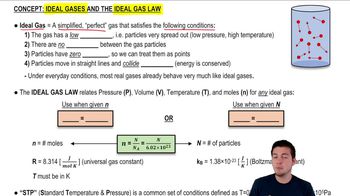
The Ideal Gas Law relates the pressure, volume, temperature, and number of moles of a gas through the equation PV = nRT. Here, P is pressure, V is volume, n is the number of moles, R is the ideal gas constant, and T is temperature. This law is fundamental for understanding the behavior of gases under various conditions and is essential for solving problems involving gas properties.
Recommended video:
Guided course
07:21
Ideal Gases and the Ideal Gas Law

Pressure and Force Relationship

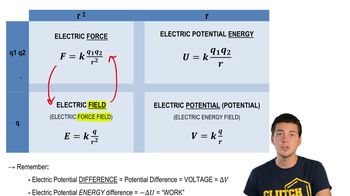
Pressure is defined as force per unit area (P = F/A). In this scenario, the force required to remove the cap is related to the pressure exerted by the gas inside the cylinder and the atmospheric pressure outside. Understanding this relationship helps in calculating the effective pressure acting on the cap and is crucial for determining the gas's temperature using the Ideal Gas Law.
Recommended video:
Guided course
03:43
Relationships Between Force, Field, Energy, Potential

Volume of a Cylinder

The volume of a cylinder can be calculated using the formula V = πr²h, where r is the radius and h is the height. In this problem, the cylinder's dimensions are given, and calculating its volume is necessary to apply the Ideal Gas Law effectively. Knowing the volume allows for the determination of the number of moles of gas present, which is essential for finding the temperature.
Recommended video:
Guided course
05:21
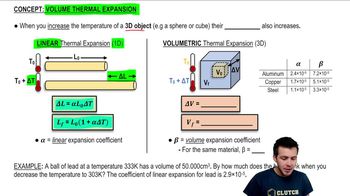
Volume Thermal Expansion
Related Practice
Textbook Question

The 3.0-m-long pipe in FIGURE P18.49 is closed at the top end. It is slowly pushed straight down into the water until the top end of the pipe is level with the water's surface. What is the length L of the trapped volume of air?

2
views
Textbook Question

The semiconductor industry manufactures integrated circuits in large vacuum chambers where the pressure is 1.0×10⁻¹⁰ mm of Hg. At T=20°C, how many molecules are in a cylindrical chamber 40 cm in diameter and 30 cm tall?

1
views
Textbook Question

The 828-m-tall Burj Khalifa in Dubai is the world's tallest building. It's essentially a steel building wrapped in exterior paneling and glass. During construction, when the beams were exposed to the elements, the building was 36 cm taller on the hottest afternoon of the year than on the coldest morning. By how much did the temperature vary throughout the year?

1
views
Textbook Question

On average, each person in the industrialized world is responsible for the emission of 10,000 kg of carbon dioxide (CO₂) every year. This includes CO₂ that you generate directly, by burning fossil fuels to operate your car or your furnace, as well as CO₂ generated on your behalf by electric generating stations and manufacturing plants. CO₂ is a greenhouse gas that contributes to global warming. If you were to store your yearly CO₂ emissions in a cube at STP, how long would each edge of the cube be?

2
views
Textbook Question

A diving bell is a 3.0-m-tall cylinder closed at the upper end but open at the lower end. The temperature of the air in the bell is 20°C. The bell is lowered into the ocean until its lower end is 100 m deep. The temperature at that depth is 10°C. How high does the water rise in the bell after enough time has passed for the air inside to reach thermal equilibrium?

1
views
Textbook Question

The semiconductor industry manufactures integrated circuits in large vacuum chambers where the pressure is 1.0×10⁻¹⁰ mm of Hg. What fraction is this of atmospheric pressure?

1
views