Ch 18: A Macroscopic Description of Matter
Knight Calc - Physics for Scientists and Engineers 5th Edition
Knight Calc5th EditionPhysics for Scientists and EngineersISBN: 9780137344796Not the one you use?Change textbook
Chapter 18, Problem 25d

A 20-cm-diameter cylinder that is 40 cm long contains 50 g of oxygen gas at 20°C. What is the reading of a pressure gauge attached to the tank?

Verified step by step guidance
1
Step 1: Convert the given dimensions of the cylinder into SI units. The diameter is 20 cm, so the radius is 10 cm or 0.1 m. The length of the cylinder is 40 cm or 0.4 m. Use these values to calculate the volume of the cylinder using the formula for the volume of a cylinder: \( V = \pi r^2 h \), where \( r \) is the radius and \( h \) is the height.
Step 2: Convert the mass of oxygen gas into moles. The given mass is 50 g, and the molar mass of oxygen (O₂) is approximately 32 g/mol. Use the formula \( n = \frac{m}{M} \), where \( n \) is the number of moles, \( m \) is the mass, and \( M \) is the molar mass.
Step 3: Use the ideal gas law \( PV = nRT \) to calculate the pressure \( P \). Rearrange the formula to solve for \( P \): \( P = \frac{nRT}{V} \). Here, \( R \) is the ideal gas constant (8.314 J/(mol·K)), \( T \) is the temperature in Kelvin, and \( V \) is the volume of the cylinder. Convert the temperature from Celsius to Kelvin using \( T(K) = T(°C) + 273.15 \).
Step 4: Substitute the values for \( n \), \( R \), \( T \), and \( V \) into the equation to calculate the pressure \( P \). Ensure all units are consistent (e.g., volume in cubic meters, temperature in Kelvin).
Step 5: The pressure gauge measures the gauge pressure, which is the absolute pressure minus atmospheric pressure. Subtract the atmospheric pressure (approximately 101,325 Pa) from the calculated absolute pressure to find the gauge pressure.

Verified video answer for a similar problem:

This video solution was recommended by our tutors as helpful for the problem above.
Video duration:
8m
Was this helpful?

Key Concepts

Here are the essential concepts you must grasp in order to answer the question correctly.

Ideal Gas Law

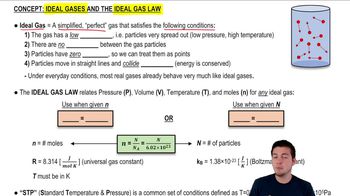
The Ideal Gas Law relates the pressure, volume, temperature, and number of moles of a gas through the equation PV = nRT. Here, P is pressure, V is volume, n is the number of moles, R is the ideal gas constant, and T is temperature in Kelvin. This law is fundamental for calculating the pressure of gases under various conditions.
Recommended video:
Guided course
07:21
Ideal Gases and the Ideal Gas Law

Volume of a Cylinder

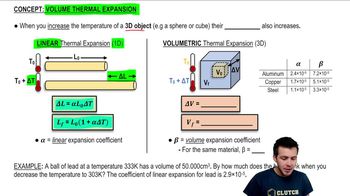
The volume of a cylinder can be calculated using the formula V = πr²h, where r is the radius and h is the height. In this case, the diameter of the cylinder is given, so the radius can be found by dividing the diameter by two. Understanding how to calculate the volume is essential for determining the amount of gas present in the cylinder.
Recommended video:
Guided course
05:21
Volume Thermal Expansion

Pressure Measurement

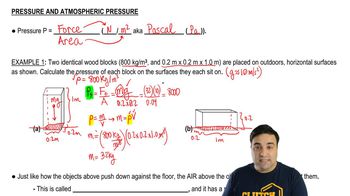
Pressure is defined as the force exerted per unit area and is commonly measured in units such as pascals (Pa) or atmospheres (atm). In the context of gases, pressure can be influenced by the amount of gas, its temperature, and the volume it occupies. Accurate pressure readings are crucial for understanding the behavior of gases in confined spaces.
Recommended video:
Guided course
17:04
Pressure and Atmospheric Pressure