Ch 18: A Macroscopic Description of Matter
Knight Calc - Physics for Scientists and Engineers 5th Edition
Knight Calc5th EditionPhysics for Scientists and EngineersISBN: 9780137344796Not the one you use?Change textbook
Chapter 18, Problem 25c

A 20-cm-diameter cylinder that is 40 cm long contains 50 g of oxygen gas at 20°C. What is the number density of the oxygen?

Verified step by step guidance
1
Step 1: Start by understanding the concept of number density. Number density is defined as the number of particles (in this case, molecules of oxygen) per unit volume. Mathematically, it is given by \( n = \frac{N}{V} \), where \( n \) is the number density, \( N \) is the total number of molecules, and \( V \) is the volume of the container.
Step 2: Calculate the volume of the cylinder. The formula for the volume of a cylinder is \( V = \pi r^2 h \), where \( r \) is the radius and \( h \) is the height (or length) of the cylinder. Convert the diameter (20 cm) to radius (10 cm) and the height (40 cm) to meters before substituting into the formula.
Step 3: Use the molar mass of oxygen to determine the number of moles of oxygen gas. The molar mass of oxygen (O₂) is approximately 32 g/mol. The number of moles \( n_{\text{moles}} \) is given by \( n_{\text{moles}} = \frac{m}{M} \), where \( m \) is the mass of the gas (50 g) and \( M \) is the molar mass.
Step 4: Use Avogadro's number to find the total number of molecules \( N \). Avogadro's number is \( 6.022 \times 10^{23} \) molecules/mol. Multiply the number of moles \( n_{\text{moles}} \) by Avogadro's number to get \( N \).
Step 5: Finally, calculate the number density \( n \) by dividing the total number of molecules \( N \) by the volume \( V \) of the cylinder. Ensure that the units are consistent (e.g., volume in cubic meters) to obtain the correct number density in molecules per cubic meter.

Verified video answer for a similar problem:

This video solution was recommended by our tutors as helpful for the problem above.
Video duration:
7m
Was this helpful?

Key Concepts

Here are the essential concepts you must grasp in order to answer the question correctly.

Number Density

Number density is defined as the number of particles (atoms, molecules, etc.) per unit volume. It is typically expressed in units such as particles per cubic meter (m³). In this context, calculating the number density of oxygen gas involves determining how many molecules are present in the given volume of the cylinder.
Recommended video:
Guided course
8:13
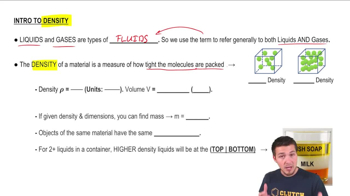
Intro to Density

Ideal Gas Law

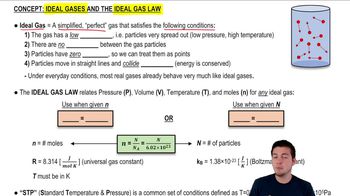
The Ideal Gas Law relates the pressure, volume, temperature, and number of moles of a gas through the equation PV = nRT. This law is essential for understanding the behavior of gases under various conditions and can be used to find the number of moles of oxygen in the cylinder, which is necessary for calculating number density.
Recommended video:
Guided course
07:21
Ideal Gases and the Ideal Gas Law

Volume of a Cylinder

The volume of a cylinder can be calculated using the formula V = πr²h, where r is the radius and h is the height. In this problem, the diameter of the cylinder is given, allowing us to find the radius and subsequently the volume, which is crucial for determining the number density of the oxygen gas contained within.
Recommended video:
Guided course
05:21
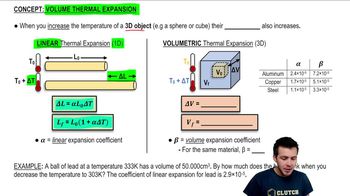
Volume Thermal Expansion