
Ch 16: Traveling Waves
Knight Calc - Physics for Scientists and Engineers 5th Edition
Knight Calc5th EditionPhysics for Scientists and EngineersISBN: 9780137344796Not the one you use?Change textbook
Chapter 16, Problem 81

An avant-garde composer wants to use the Doppler effect in his new opera. As the soprano sings, he wants a large bat to fly toward her from the back of the stage. The bat will be outfitted with a microphone to pick up the singer's voice and a loudspeaker to rebroadcast the sound toward the audience. The composer wants the sound the audience hears from the bat to be, in musical terms, one half-step higher in frequency than the note they are hearing from the singer. Two notes a half-step apart have a frequency ratio of 21/12 = 1.059. With what speed must the bat fly toward the singer?

Verified step by step guidance
1
Step 1: Understand the Doppler effect. The Doppler effect describes how the frequency of a wave changes for an observer moving relative to the source of the wave. In this case, the bat is moving toward the soprano, and the audience hears the sound rebroadcasted by the bat. The frequency shift is determined by the relative motion between the bat and the soprano.
Step 2: Write the formula for the observed frequency due to the Doppler effect. The frequency observed by the bat (f_bat) is given by: fbat=fsinger×v+vbatv, where v is the speed of sound in air, v_bat is the speed of the bat, and f_singer is the frequency of the soprano's voice.
Step 3: Write the formula for the frequency rebroadcasted by the bat. The audience hears the frequency rebroadcasted by the bat (f_audience), which is the same as f_bat because the bat is stationary relative to the audience. The composer wants f_audience to be one half-step higher than f_singer, meaning: faudience=fsinger×212.
Step 4: Combine the equations. Substitute f_audience = f_bat into the Doppler effect formula and set f_bat equal to the desired frequency ratio: fsinger×212=fsinger×v+vbatv. Cancel out f_singer from both sides and solve for v_bat.
Step 5: Solve for v_bat. Rearrange the equation to isolate v_bat: vbat=v×(212-1). Plug in the value of v (speed of sound in air, approximately 343 m/s) and calculate v_bat.

Verified video answer for a similar problem:

This video solution was recommended by our tutors as helpful for the problem above.
Video duration:
12m
Was this helpful?

Key Concepts

Here are the essential concepts you must grasp in order to answer the question correctly.

Doppler Effect

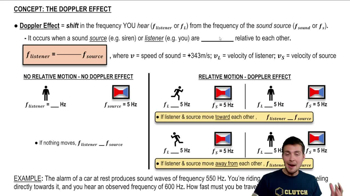
The Doppler effect is the change in frequency or wavelength of a wave in relation to an observer moving relative to the wave source. When the source of sound moves toward an observer, the frequency increases, resulting in a higher pitch. Conversely, if the source moves away, the frequency decreases, leading to a lower pitch. This phenomenon is crucial for understanding how the bat's movement will affect the sound frequency heard by the audience.
Recommended video:
Guided course
07:40
The Doppler Effect

Frequency and Musical Intervals

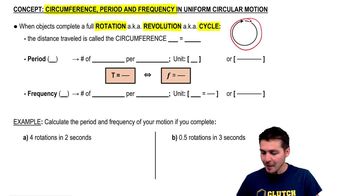
Frequency refers to the number of cycles of a wave that occur in a second, measured in Hertz (Hz). In music, different frequencies correspond to different pitches, and musical intervals describe the relationship between these pitches. A half-step interval, for example, corresponds to a frequency ratio of approximately 1.059, meaning that the higher note is about 5.9% higher in frequency than the lower note. This concept is essential for determining the required frequency shift in the sound heard by the audience.
Recommended video:
Guided course
05:08
Circumference, Period, and Frequency in UCM

Relative Velocity and Sound Propagation

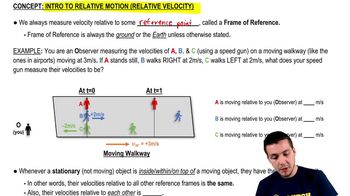
Relative velocity in the context of sound involves the speed of the sound source (the bat) and the speed of sound in the medium (air). The speed of sound in air is approximately 343 meters per second at room temperature. To achieve the desired frequency shift, the bat must fly at a specific speed toward the singer, which can be calculated using the Doppler effect formula. Understanding this relationship is key to solving the problem of how fast the bat needs to fly.
Recommended video:
Guided course
04:27
Intro to Relative Motion (Relative Velocity)
Related Practice
Textbook Question

A communications truck with a 44-cm-diameter dish receiver on the roof starts out 10 km from its base station. It drives directly away from the base station at 50 km/h for 1.0 h, keeping the receiver pointed at the base station. The base station antenna broadcasts continuously with 2.5 kW of power, radiated uniformly in all directions. How much electromagnetic energy does the truck's dish receive during that 1.0 h?

1
views
Textbook Question

A battery-powered siren emits 0.50 W of sound power at 1000 Hz. It is dropped from 100 m directly over your head on a 20°C day. 4.0 s after it is released, what are (a) the frequency and (b) the sound intensity level you hear?

1
views
Textbook Question

A loudspeaker, mounted on a tall pole, is engineered to emit 75% of its sound energy into the forward hemisphere, 25% toward the back. You measure an 85 dB sound intensity level when standing 3.5 m in front of and 2.5 m below the speaker. What is the speaker's power output?

2
views
Textbook Question

A physics professor demonstrates the Doppler effect by tying a 600 Hz sound generator to a 1.0-m-long rope and whirling it around her head in a horizontal circle at 100 rpm. What are the highest and lowest frequencies heard by a student in the classroom?

2
views
Textbook Question

Some modern optical devices are made with glass whose index of refraction changes with distance from the front surface. FIGURE P16.72 shows the index of refraction as a function of the distance into a slab of glass of thickness L. The index of refraction increases linearly from n1 at the front surface to n₂ at the rear surface. Evaluate your expression for a 1.0-cm-thick piece of glass for which n1 = 1.50 and n2 = 1.60.