
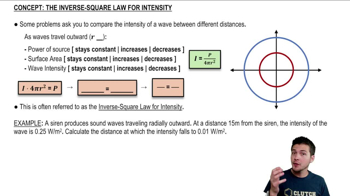
A communications truck with a 44-cm-diameter dish receiver on the roof starts out 10 km from its base station. It drives directly away from the base station at 50 km/h for 1.0 h, keeping the receiver pointed at the base station. The base station antenna broadcasts continuously with 2.5 kW of power, radiated uniformly in all directions. How much electromagnetic energy does the truck's dish receive during that 1.0 h?
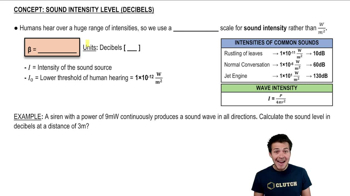
A loudspeaker, mounted on a tall pole, is engineered to emit 75% of its sound energy into the forward hemisphere, 25% toward the back. You measure an 85 dB sound intensity level when standing 3.5 m in front of and 2.5 m below the speaker. What is the speaker's power output?
Verified step by step guidance
Verified video answer for a similar problem:
Key Concepts
Sound Intensity Level
Inverse Square Law
Acoustic Power Output
An avant-garde composer wants to use the Doppler effect in his new opera. As the soprano sings, he wants a large bat to fly toward her from the back of the stage. The bat will be outfitted with a microphone to pick up the singer's voice and a loudspeaker to rebroadcast the sound toward the audience. The composer wants the sound the audience hears from the bat to be, in musical terms, one half-step higher in frequency than the note they are hearing from the singer. Two notes a half-step apart have a frequency ratio of 21/12 = 1.059. With what speed must the bat fly toward the singer?
A physics professor demonstrates the Doppler effect by tying a 600 Hz sound generator to a 1.0-m-long rope and whirling it around her head in a horizontal circle at 100 rpm. What are the highest and lowest frequencies heard by a student in the classroom?
Some modern optical devices are made with glass whose index of refraction changes with distance from the front surface. FIGURE P16.72 shows the index of refraction as a function of the distance into a slab of glass of thickness L. The index of refraction increases linearly from n1 at the front surface to n₂ at the rear surface. Evaluate your expression for a 1.0-cm-thick piece of glass for which n1 = 1.50 and n2 = 1.60.
