Ch 11: Impulse and Momentum
Knight Calc - Physics for Scientists and Engineers 5th Edition
Knight Calc5th EditionPhysics for Scientists and EngineersISBN: 9780137344796Not the one you use?Change textbook
Chapter 11, Problem 26a

A 70.00 kg football player is gliding across very smooth ice at 2.00 m/s. He throws a 0.450 kg football straight forward. What is the player's speed afterward if the ball is thrown at 15.0 m/s relative to the ground?

Verified step by step guidance
1
Step 1: Identify the principle of conservation of momentum. Since there are no external forces acting on the system (player + football), the total momentum before and after the throw must remain constant.
Step 2: Write the equation for the total momentum before the throw. The initial momentum of the system is the sum of the player's momentum and the football's momentum. Since the football is initially moving with the player, its initial velocity is the same as the player's velocity. The total initial momentum is given by: pinitial = (mplayer)(vplayer) + (mfootball)(vfootball), where vfootball = vplayer.
Step 3: Write the equation for the total momentum after the throw. After the throw, the player and the football have different velocities. The total final momentum is given by: pfinal = (mplayer)(vplayer, final) + (mfootball)(vfootball, final), where vfootball, final is the velocity of the football relative to the ground.
Step 4: Set the total initial momentum equal to the total final momentum, as momentum is conserved. This gives: (mplayer)(vplayer) + (mfootball)(vfootball) = (mplayer)(vplayer, final) + (mfootball)(vfootball, final). Substitute the known values for the masses and velocities into this equation.
Step 5: Solve for the player's final velocity, vplayer, final. Rearrange the equation to isolate vplayer, final on one side. This will involve subtracting the momentum contribution of the football from both sides and dividing by the player's mass. The resulting expression will give the player's final velocity.

Verified video answer for a similar problem:

This video solution was recommended by our tutors as helpful for the problem above.
Video duration:
7m
Was this helpful?

Key Concepts

Here are the essential concepts you must grasp in order to answer the question correctly.

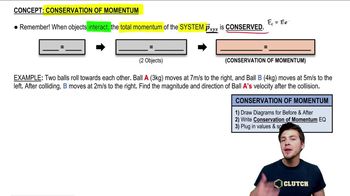
Conservation of Momentum

The conservation of momentum states that in a closed system, the total momentum before an event must equal the total momentum after the event, provided no external forces act on it. In this scenario, the football player and the football form a closed system where the initial momentum is the sum of their individual momenta before the throw, and the final momentum is the sum after the throw.
Recommended video:
Guided course
05:58
Conservation Of Momentum

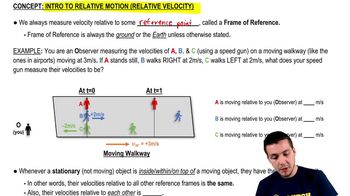
Relative Velocity

Relative velocity refers to the velocity of one object as observed from another object. In this question, the speed of the football is given relative to the ground, which means we need to account for both the player's initial speed and the speed of the ball to find the player's new speed after the throw.
Recommended video:
Guided course
04:27
Intro to Relative Motion (Relative Velocity)

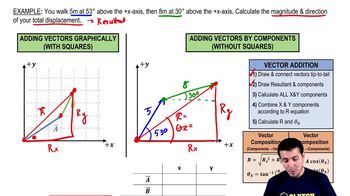
Vector Addition

Vector addition is the process of combining two or more vectors to determine a resultant vector. In this case, the player's speed and the speed of the football must be treated as vectors, taking into account their directions to accurately calculate the player's final speed after the football is thrown.
Recommended video:
Guided course
07:30
Vector Addition By Components