Ch 11: Impulse and Momentum
Knight Calc - Physics for Scientists and Engineers 5th Edition
Knight Calc5th EditionPhysics for Scientists and EngineersISBN: 9780137344796Not the one you use?Change textbook
Chapter 11, Problem 23

A 50 g marble moving at 2.0 m/s strikes a 20 g marble at rest. What is the speed of each marble immediately after the collision?

Verified step by step guidance
1
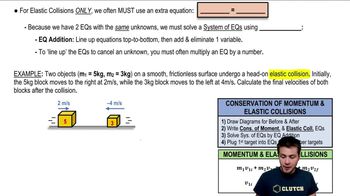
Identify the type of collision: Since the problem does not specify whether the collision is elastic or inelastic, assume it is an elastic collision (as is common in such problems unless stated otherwise). In an elastic collision, both momentum and kinetic energy are conserved.
Write the equation for conservation of momentum: The total momentum before the collision equals the total momentum after the collision. Use the formula: m1v1i + m2v2i = m1v1f + m2v2f, where m1 and m2 are the masses of the marbles, v1i and v2i are their initial velocities, and v1f and v2f are their final velocities.
Write the equation for conservation of kinetic energy: Since the collision is elastic, the total kinetic energy before the collision equals the total kinetic energy after the collision. Use the formula: 1/2 m1v1i2 + 1/2 m2v2i2 = 1/2 m1v1f2 + 1/2 m2v2f2.
Substitute the given values into the equations: Use m1 = 50 \(\text{ g}\) = 0.050 \(\text{ kg}\), m2 = 20 \(\text{ g}\) = 0.020 \(\text{ kg}\), v1i = 2.0 \(\text{ m/s}\), and v2i = 0 \(\text{ m/s}\). Solve the system of equations for v1f and v2f.
Solve the system of equations: Use algebraic methods to solve the two equations (momentum and kinetic energy conservation) simultaneously. This will yield the final velocities v1f and v2f for the two marbles.

Verified video answer for a similar problem:

This video solution was recommended by our tutors as helpful for the problem above.
Video duration:
16m
Was this helpful?

Key Concepts

Here are the essential concepts you must grasp in order to answer the question correctly.

Conservation of Momentum

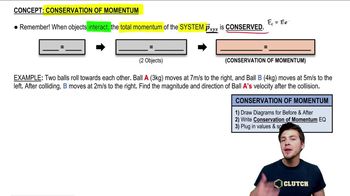
The principle of conservation of momentum states that in a closed system, the total momentum before an event (like a collision) is equal to the total momentum after the event. This means that the momentum lost by one object is gained by another, allowing us to set up equations to solve for unknown velocities after the collision.
Recommended video:
Guided course
05:58
Conservation Of Momentum

Elastic vs. Inelastic Collisions

Collisions can be classified as elastic or inelastic. In elastic collisions, both momentum and kinetic energy are conserved, while in inelastic collisions, momentum is conserved but kinetic energy is not. The problem does not specify the type of collision, but understanding this distinction is crucial for determining how to approach the calculations.
Recommended video:
Guided course
08:56
Intro To Elastic Collisions

Mass and Velocity Relationship

The relationship between mass and velocity is fundamental in physics, particularly in momentum calculations. Momentum (p) is defined as the product of mass (m) and velocity (v), expressed as p = mv. This relationship allows us to analyze how changes in mass or velocity affect the overall momentum of the system during collisions.
Recommended video:
Guided course
20:32
Mass Spectrometers
Related Practice
Textbook Question

A 30 g dart traveling horizontally hits and sticks in the back of a 500 g toy car, causing the car to roll forward at 1.4 m/s. What was the speed of the dart?

Textbook Question

Fred (mass 60 kg) is running with the football at a speed of 6.0 m/s when he is met head-on by Brutus (mass 120 kg), who is moving at 4.0 m/s. Brutus grabs Fred in a tight grip, and they fall to the ground. Which way do they slide, and how far? The coefficient of kinetic friction between football uniforms and Astroturf is 0.30.

Textbook Question

A 70.00 kg football player is gliding across very smooth ice at 2.00 m/s. He throws a 0.450 kg football straight forward. What is the player's speed afterward if the ball is thrown at 15.0 m/s relative to the ground?

1
views
Textbook Question

A 50 g ball of clay traveling at speed v0 hits and sticks to a 1.0 kg brick sitting at rest on a frictionless surface. What is the speed of the brick after the collision?

1
views
Textbook Question

A proton is traveling to the right at 2.0 x 10⁷ m/s. It has a head-on perfectly elastic collision with a carbon atom. The mass of the carbon atom is 12 times the mass of the proton. What are the speed and direction of each after the collision?

1
views
Textbook Question

A package of mass m is released from rest at a warehouse loading dock and slides down the 3.0-m-high, frictionless chute of FIGURE EX11.24 to a waiting truck. Unfortunately, the truck driver went on a break without having removed the previous package, of mass 2m, from the bottom of the chute. Suppose the collision between the packages is perfectly elastic. To what height does the package of mass m rebound?

1
views