
In a physics lab experiment, a compressed spring launches a 20 g metal ball at a 30° angle. Compressing the spring 20 cm causes the ball to hit the floor 1.5 m below the point at which it leaves the spring after traveling 5.0 m horizontally. What is the spring constant?
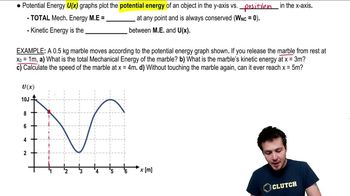
CALC The potential energy for a particle that can move along the x-axis is U = Ax2 + B sin(πx/L), where A, B, and L are constants. What is the force on the particle at (a) x = 0, (b) x = L/2, and (c) x = L?
Verified step by step guidance
Verified video answer for a similar problem:
Key Concepts
Potential Energy
Force and Potential Energy Relationship
Differentiation
CALC An object moving in the xy-plane is subjected to the force , where x and y are in m. Is this a conservative force?
A particle that can move along the x-axis is part of a system with potential energy U(x) = A/x2 − B/x where A and B are positive constants. Where are the particle's equilibrium positions?
CALC An object moving in the xy-plane is subjected to the force , where x and y are in m. The particle moves from the origin to the point with coordinates (a, b) by moving first along the x-axis to (a, 0), then parallel to the y-axis. How much work does the force do?
A 100 g particle experiences the one-dimensional, conservative force Fx shown in FIGURE P10.60. Suppose the particle is shot to the right from x = 1.0 m with a speed of 25 m/s. Where is its turning point?
A clever engineer designs a 'sprong' that obeys the force law Fx=−q(x−xeq)³ , where xeq is the equilibrium position of the end of the sprong and q is the sprong constant. For simplicity, we'll let xeq = 0 m .Then Fx = −qx³. Find an expression for the potential energy of a stretched or compressed sprong.
