Ch 10: Interactions and Potential Energy
Knight Calc - Physics for Scientists and Engineers 5th Edition
Knight Calc5th EditionPhysics for Scientists and EngineersISBN: 9780137344796Not the one you use?Change textbook
Chapter 10, Problem 62b

A clever engineer designs a 'sprong' that obeys the force law Fx=−q(x−xeq)³ , where xeq is the equilibrium position of the end of the sprong and q is the sprong constant. For simplicity, we'll let xeq = 0 m .Then Fx = −qx³. Find an expression for the potential energy of a stretched or compressed sprong.

Verified step by step guidance
1
Step 1: Recall the relationship between force and potential energy. The force is the negative gradient of the potential energy, expressed as Fx = -dU/dx, where U is the potential energy and Fx is the force acting on the object.
Step 2: Substitute the given force law Fx = -q * x³ into the equation Fx = -dU/dx. This gives -q * x³ = -dU/dx.
Step 3: Rearrange the equation to isolate dU/dx. This results in dU/dx = q * x³.
Step 4: Integrate dU/dx with respect to x to find the potential energy U(x). The integral of q * x³ with respect to x is ∫(q * x³) dx = (q/4) * x⁴ + C, where C is the constant of integration.
Step 5: Determine the constant of integration C based on the physical context. Typically, the potential energy is set to zero at the equilibrium position (x = 0). Substituting x = 0 into U(x) = (q/4) * x⁴ + C gives C = 0. Thus, the final expression for the potential energy is U(x) = (q/4) * x⁴.

Verified video answer for a similar problem:

This video solution was recommended by our tutors as helpful for the problem above.
Video duration:
2m
Was this helpful?

Key Concepts

Here are the essential concepts you must grasp in order to answer the question correctly.

Force and Potential Energy Relationship

In physics, the relationship between force and potential energy is fundamental. The work done by a force when moving an object from one position to another is equal to the change in potential energy. For a conservative force, such as the one described in the question, the potential energy can be derived by integrating the force over the displacement.
Recommended video:
Guided course
03:43
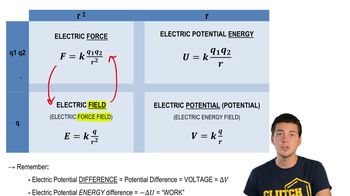
Relationships Between Force, Field, Energy, Potential

Integration of Force to Find Potential Energy

To find the potential energy associated with a force, we integrate the force function with respect to position. In this case, the force Fx = -qx³ indicates that the potential energy U can be found by calculating U(x) = -∫Fx dx. This process allows us to determine how energy is stored in the system as the sprong is either stretched or compressed.
Recommended video:
Guided course
11:43
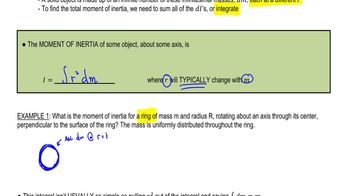
Finding Moment Of Inertia By Integrating

Equilibrium Position and Stability

The equilibrium position, where the net force acting on an object is zero, is crucial for understanding the behavior of systems like the sprong. In this scenario, xeq = 0 m is the point of equilibrium. The stability of this position can be analyzed by examining the potential energy curve; if the potential energy increases as the position moves away from xeq, the equilibrium is stable, indicating that the sprong will return to this position when disturbed.
Recommended video:
Guided course
05:50
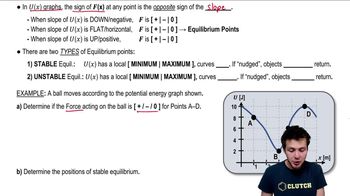
Forces & Equilibrium Positions
Related Practice
Textbook Question

CALC The potential energy for a particle that can move along the x-axis is U = Ax2 + B sin(πx/L), where A, B, and L are constants. What is the force on the particle at (a) x = 0, (b) x = L/2, and (c) x = L?

1
views

Textbook Question

CALC An object moving in the xy-plane is subjected to the force F=(2xyi^+x2j^)N\(\vec{F}\) = (2xy\,\(\hat{i}\) + x^2\,\(\hat{j}\))\,\(\text{N}\), where x and y are in m. Is this a conservative force?

Textbook Question

A particle that can move along the x-axis is part of a system with potential energy U(x) = A/x2 − B/x where A and B are positive constants. Where are the particle's equilibrium positions?

2
views
Textbook Question

CALC An object moving in the xy-plane is subjected to the force F=(2xyi^+x2j^)N\(\vec{F}\) = (2xy\,\(\hat{i}\) + x^2\,\(\hat{j}\))\,\(\text{N}\), where x and y are in m. The particle moves from the origin to the point with coordinates (a, b) by moving first along the x-axis to (a, 0), then parallel to the y-axis. How much work does the force do?

Textbook Question

A 100 g particle experiences the one-dimensional, conservative force Fx shown in FIGURE P10.60. Suppose the particle is shot to the right from x = 1.0 m with a speed of 25 m/s. Where is its turning point?

1
views
Textbook Question

A 100 g particle experiences the one-dimensional, conservative force Fx shown in FIGURE P10.60. Let the zero of potential energy be at x = 0 m . What is the potential energy at x = 1.0, 2.0, 3.0, and 4.0 m? Hint: Use the definition of potential energy and the geometric interpretation of work.

1
views