Ch 10: Interactions and Potential Energy
Knight Calc - Physics for Scientists and Engineers 5th Edition
Knight Calc5th EditionPhysics for Scientists and EngineersISBN: 9780137344796Not the one you use?Change textbook
Chapter 10, Problem 9

A 20 kg child is on a swing that hangs from 3.0-m-long chains. What is her maximum speed if she swings out to a 45° angle?

Verified step by step guidance
1
Determine the height difference between the highest point of the swing and the lowest point. Use trigonometry to calculate this. The height difference can be found using the formula: \( h = L - L \cos(\theta) \), where \( L \) is the length of the chain (3.0 m) and \( \theta \) is the angle (45 degrees).
Calculate the potential energy at the highest point of the swing relative to the lowest point. Use the formula: \( PE = mgh \), where \( m \) is the mass of the child (20 kg), \( g \) is the acceleration due to gravity (9.8 m/s^2), and \( h \) is the height difference calculated in the previous step.
At the lowest point of the swing, all the potential energy is converted into kinetic energy (assuming no energy loss due to air resistance or friction). Use the conservation of energy principle: \( PE_{\text{highest}} = KE_{\text{lowest}} \). The kinetic energy is given by \( KE = \frac{1}{2}mv^2 \), where \( v \) is the speed at the lowest point.
Rearrange the kinetic energy formula to solve for \( v \): \( v = \sqrt{2gh} \). Substitute the value of \( h \) from step 1 and \( g \) to find the maximum speed.
Perform the substitution and simplify the expression to find the numerical value of \( v \). This will give the maximum speed of the child at the lowest point of the swing.

Verified video answer for a similar problem:

This video solution was recommended by our tutors as helpful for the problem above.
Video duration:
10m
Was this helpful?

Key Concepts

Here are the essential concepts you must grasp in order to answer the question correctly.

Conservation of Energy

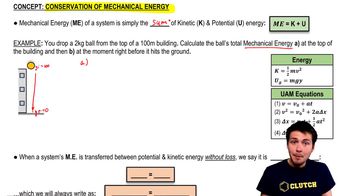
The principle of conservation of energy states that energy cannot be created or destroyed, only transformed from one form to another. In the context of the swing, the potential energy at the highest point of the swing is converted into kinetic energy at the lowest point. This relationship allows us to calculate the maximum speed of the child by equating the potential energy at the 45-degree angle to the kinetic energy at the lowest point.
Recommended video:
Guided course
06:24
Conservation Of Mechanical Energy

Potential Energy

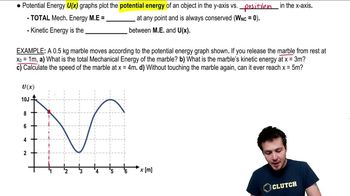
Potential energy is the energy stored in an object due to its position or configuration. For the child on the swing, gravitational potential energy is given by the formula PE = mgh, where m is mass, g is the acceleration due to gravity, and h is the height above a reference point. When the swing is at a 45-degree angle, the height can be calculated using trigonometric functions, which is essential for determining the potential energy at that position.
Recommended video:
Guided course
07:24
Potential Energy Graphs

Kinetic Energy

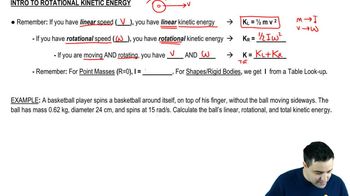
Kinetic energy is the energy of an object in motion, defined by the formula KE = 0.5mv², where m is mass and v is velocity. As the child swings down from the 45-degree angle to the lowest point, the potential energy is converted into kinetic energy, reaching its maximum at the lowest point. Understanding this concept is crucial for calculating the maximum speed of the child as she swings.
Recommended video:
Guided course
06:07
Intro to Rotational Kinetic Energy
Related Practice
Textbook Question

A pendulum is made by tying a 500 g ball to a 75-cm-long string. The pendulum is pulled 30° to one side, then released. What is the ball's speed at the lowest point of its trajectory?

1
views

Textbook Question

The free-fall acceleration on a large asteroid, in the vacuum of space, is 0.15 m/s2. A spacecraft hovering 500 m above the surface drops a 25 kg payload wrapped in a padded jacket. What is the payload's impact speed?

4
views
Textbook Question
The spring in FIGURE EX10.21a is compressed by 10 cm. It launches a block across a frictionless surface at 0.50 m/s. The two springs in Figure EX10.21b are identical to the spring of Figure EX10.21a. They are compressed by the same 10 cm and launch the same block. What is the block's speed now?
2
views
Textbook Question

A 55 kg skateboarder wants to just make it to the upper edge of a 'quarter pipe,' a track that is one-quarter of a circle with a radius of 3.0 m. What speed does he need at the bottom?

1
views
Textbook Question

A 1500 kg car traveling at 10 m/s suddenly runs out of gas while approaching the valley shown in FIGURE EX10.11. The alert driver immediately puts the car in neutral so that it will roll. What will be the car's speed as it coasts into the gas station on the other side of the valley? Ignore rolling friction.

Textbook Question

A system consists of interacting objects A and B, each exerting a constant 3.0 N pull on the other. What is ∆U for the system if A moves 1.0 m toward B while B moves 2.0 m toward A?

1
views