Ch 10: Interactions and Potential Energy
Knight Calc - Physics for Scientists and Engineers 5th Edition
Knight Calc5th EditionPhysics for Scientists and EngineersISBN: 9780137344796Not the one you use?Change textbook
Chapter 10, Problem 11

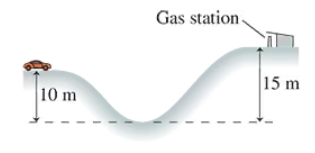
A 1500 kg car traveling at 10 m/s suddenly runs out of gas while approaching the valley shown in FIGURE EX10.11. The alert driver immediately puts the car in neutral so that it will roll. What will be the car's speed as it coasts into the gas station on the other side of the valley? Ignore rolling friction.

Verified step by step guidance
1
Identify the principle of conservation of mechanical energy: Since there is no friction or external work done on the system, the total mechanical energy (kinetic energy + potential energy) of the car remains constant throughout its motion.
Write the expression for the total mechanical energy at the initial position (top of the hill): \( E_{initial} = \frac{1}{2} m v_{initial}^2 + m g h_{initial} \), where \( m \) is the mass of the car, \( v_{initial} \) is the initial velocity, \( g \) is the acceleration due to gravity, and \( h_{initial} \) is the initial height.
Write the expression for the total mechanical energy at the final position (gas station): \( E_{final} = \frac{1}{2} m v_{final}^2 + m g h_{final} \), where \( v_{final} \) is the final velocity and \( h_{final} \) is the height of the gas station.
Set \( E_{initial} = E_{final} \) because mechanical energy is conserved. This gives the equation: \( \frac{1}{2} m v_{initial}^2 + m g h_{initial} = \frac{1}{2} m v_{final}^2 + m g h_{final} \).
Simplify the equation by canceling the mass \( m \) (since it appears in every term) and solve for \( v_{final} \): \( v_{final} = \sqrt{v_{initial}^2 + 2 g (h_{initial} - h_{final})} \). Substitute the given values for \( v_{initial} \), \( g \), \( h_{initial} \), and \( h_{final} \) to find the final speed.

Verified video answer for a similar problem:

This video solution was recommended by our tutors as helpful for the problem above.
Was this helpful?

Key Concepts

Here are the essential concepts you must grasp in order to answer the question correctly.

Conservation of Energy

The principle of conservation of energy states that in a closed system, the total energy remains constant. In this scenario, the car's initial kinetic energy, derived from its mass and speed, will convert into potential energy as it ascends the valley and back into kinetic energy as it descends. This concept is crucial for determining the car's speed at different points in its motion.
Recommended video:
Guided course
06:24
Conservation Of Mechanical Energy

Kinetic Energy

Kinetic energy is the energy an object possesses due to its motion, calculated using the formula KE = 1/2 mv², where m is mass and v is velocity. In this problem, the car's initial kinetic energy will play a significant role in understanding how it will behave as it moves through the valley, especially as it transitions between kinetic and potential energy.
Recommended video:
Guided course
06:07
Intro to Rotational Kinetic Energy

Potential Energy

Potential energy is the stored energy of an object based on its position in a gravitational field, calculated using PE = mgh, where m is mass, g is the acceleration due to gravity, and h is height. As the car moves up the valley, it gains potential energy, which will be converted back into kinetic energy as it descends, affecting its final speed when it reaches the gas station.
Recommended video:
Guided course
07:24
Potential Energy Graphs
Related Practice
Textbook Question

A pendulum is made by tying a 500 g ball to a 75-cm-long string. The pendulum is pulled 30° to one side, then released. What is the ball's speed at the lowest point of its trajectory?

1
views

Textbook Question
The spring in FIGURE EX10.21a is compressed by 10 cm. It launches a block across a frictionless surface at 0.50 m/s. The two springs in Figure EX10.21b are identical to the spring of Figure EX10.21a. They are compressed by the same 10 cm and launch the same block. What is the block's speed now?
2
views
Textbook Question

The maximum energy a bone can absorb without breaking is surprisingly small. Experimental data show that a leg bone of a healthy, 60 kg human can absorb about 200 J. From what maximum height could a 60 kg person jump and land rigidly upright on both feet without breaking his legs? Assume that all energy is absorbed by the leg bones in a rigid landing.

Textbook Question

In a hydroelectric dam, water falls 25 m and then spins a turbine to generate electricity. Suppose the dam is 80% efficient at converting the water's potential energy to electrical energy. How many kilograms of water must pass through the turbines each second to generate 50 MW of electricity? This is a typical value for a small hydroelectric dam.

1
views
Textbook Question

A 20 kg child is on a swing that hangs from 3.0-m-long chains. What is her maximum speed if she swings out to a 45° angle?

Textbook Question

In a hydroelectric dam, water falls 25 m and then spins a turbine to generate electricity. What is ΔUG\(\Delta\) U_{G} of 1.0 kg of water?