Ch 09: Work and Kinetic Energy
Knight Calc - Physics for Scientists and Engineers 5th Edition
Knight Calc5th EditionPhysics for Scientists and EngineersISBN: 9780137344796Not the one you use?Change textbook
Chapter 9, Problem 18

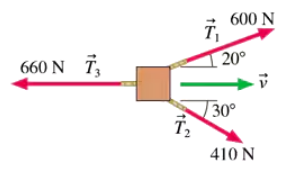
The three ropes shown in the bird's-eye view of FIGURE EX9.18 are used to drag a crate 3.0 m across the floor. How much work is done by each of the three forces?

Verified step by step guidance
1
Identify the forces acting on the crate. From the problem, there are three forces applied via ropes. Let these forces be \( F_1 \), \( F_2 \), and \( F_3 \), each with a specific magnitude and direction. The directions of the forces are given in the figure (not provided here). Work is calculated for each force individually.
Recall the formula for work: \( W = F \cdot d \cdot \cos(\theta) \), where \( F \) is the magnitude of the force, \( d \) is the displacement (3.0 m in this case), and \( \theta \) is the angle between the force and the direction of displacement.
For each force, determine the angle \( \theta \) between the force vector and the displacement vector. Use the information provided in the figure to identify these angles.
Substitute the values of \( F \), \( d \), and \( \cos(\theta) \) into the work formula for each force. For example, for \( F_1 \), the work done is \( W_1 = F_1 \cdot 3.0 \cdot \cos(\theta_1) \). Repeat this process for \( F_2 \) and \( F_3 \).
Add the calculated work values for each force if the problem requires the total work done on the crate. Otherwise, report the work done by each force individually as \( W_1 \), \( W_2 \), and \( W_3 \).

Verified video answer for a similar problem:

This video solution was recommended by our tutors as helpful for the problem above.
Video duration:
6m
Was this helpful?

Key Concepts

Here are the essential concepts you must grasp in order to answer the question correctly.

Work

In physics, work is defined as the product of the force applied to an object and the distance over which that force is applied, specifically in the direction of the force. Mathematically, it is expressed as W = F × d × cos(θ), where W is work, F is the force, d is the distance, and θ is the angle between the force and the direction of motion. Understanding this concept is crucial for calculating the work done by each rope in moving the crate.
Recommended video:
Guided course
06:58
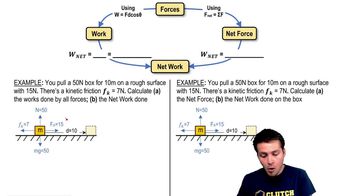
Calculating Net Work

Force Components

When multiple forces act on an object, it is essential to analyze their components, particularly in relation to the direction of motion. Forces can be broken down into horizontal and vertical components, which can be calculated using trigonometric functions. This breakdown allows for a clearer understanding of how much of each force contributes to the work done in moving the crate across the floor.
Recommended video:
Guided course
07:30
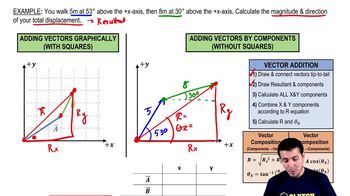
Vector Addition By Components

Friction

Friction is the resistive force that opposes the motion of an object sliding across a surface. It is influenced by the nature of the surfaces in contact and the normal force acting on the object. In the context of dragging the crate, understanding friction is vital, as it affects the net force acting on the crate and, consequently, the total work done by the applied forces.
Recommended video:
Guided course
08:11
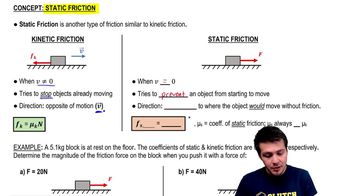
Static Friction & Equilibrium
Related Practice