Ch 09: Work and Kinetic Energy
Knight Calc - Physics for Scientists and Engineers 5th Edition
Knight Calc5th EditionPhysics for Scientists and EngineersISBN: 9780137344796Not the one you use?Change textbook
Chapter 9, Problem 17

A 25 kg air compressor is dragged up a rough incline from r1=(1.3ı^+1.3ȷ^)m\(\vec{r}\)_1 = (1.3\(\hat{\imath}\) + 1.3\(\hat{\jmath}\)) \, \(\text{m}\) to r2=(8.3ı^+2.9ȷ^)m\(\vec{r}\)_2 = (8.3\(\hat{\imath}\) + 2.9\(\hat{\jmath}\)) \, \(\text{m}\), to where the y-axis is vertical. How much work does gravity do on the compressor during this displacement?

Verified step by step guidance
1
Identify the displacement vector by subtracting the initial position vector \( \mathbf{r}_1 \) from the final position vector \( \mathbf{r}_2 \). The displacement vector \( \mathbf{\Delta r} \) is given by \( \mathbf{\Delta r} = \mathbf{r}_2 - \mathbf{r}_1 \).
Calculate the displacement vector components: \( \mathbf{\Delta r} = (8.3 - 1.3)\hat{i} + (2.9 - 1.3)\hat{j} \). Simplify to find \( \mathbf{\Delta r} = 7.0\hat{i} + 1.6\hat{j} \).
Determine the vertical displacement (\( \Delta y \)) since gravity acts vertically. From the displacement vector, \( \Delta y \) is the change in the \( j \)-component: \( \Delta y = 2.9 - 1.3 \).
Use the formula for work done by gravity: \( W = -mg\Delta y \), where \( m \) is the mass of the object (25 kg), \( g \) is the acceleration due to gravity (9.8 m/s²), and \( \Delta y \) is the vertical displacement.
Substitute the known values into the formula: \( W = -(25)(9.8)(\Delta y) \). Simplify the expression to find the work done by gravity.

Verified video answer for a similar problem:

This video solution was recommended by our tutors as helpful for the problem above.
Video duration:
7m
Was this helpful?

Key Concepts

Here are the essential concepts you must grasp in order to answer the question correctly.

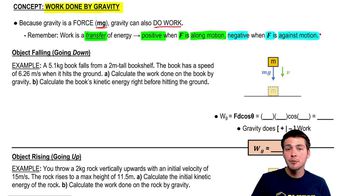
Work Done by Gravity

Work done by gravity is calculated as the product of the gravitational force acting on an object and the vertical displacement of that object. The formula is W = F_g * d_y, where F_g is the weight of the object (mass times gravitational acceleration) and d_y is the change in height. This concept is crucial for determining how much energy is transferred due to the gravitational force during the object's movement.
Recommended video:
Guided course
06:34
Work Done By Gravity

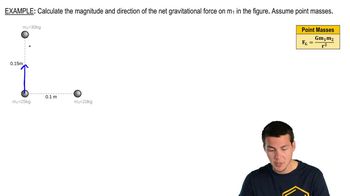
Gravitational Force

The gravitational force acting on an object is given by F_g = m * g, where m is the mass of the object and g is the acceleration due to gravity (approximately 9.81 m/s² on Earth). This force acts downward towards the center of the Earth and is essential for calculating the work done by gravity as the object moves along an incline.
Recommended video:
Guided course
05:41
Gravitational Forces in 2D

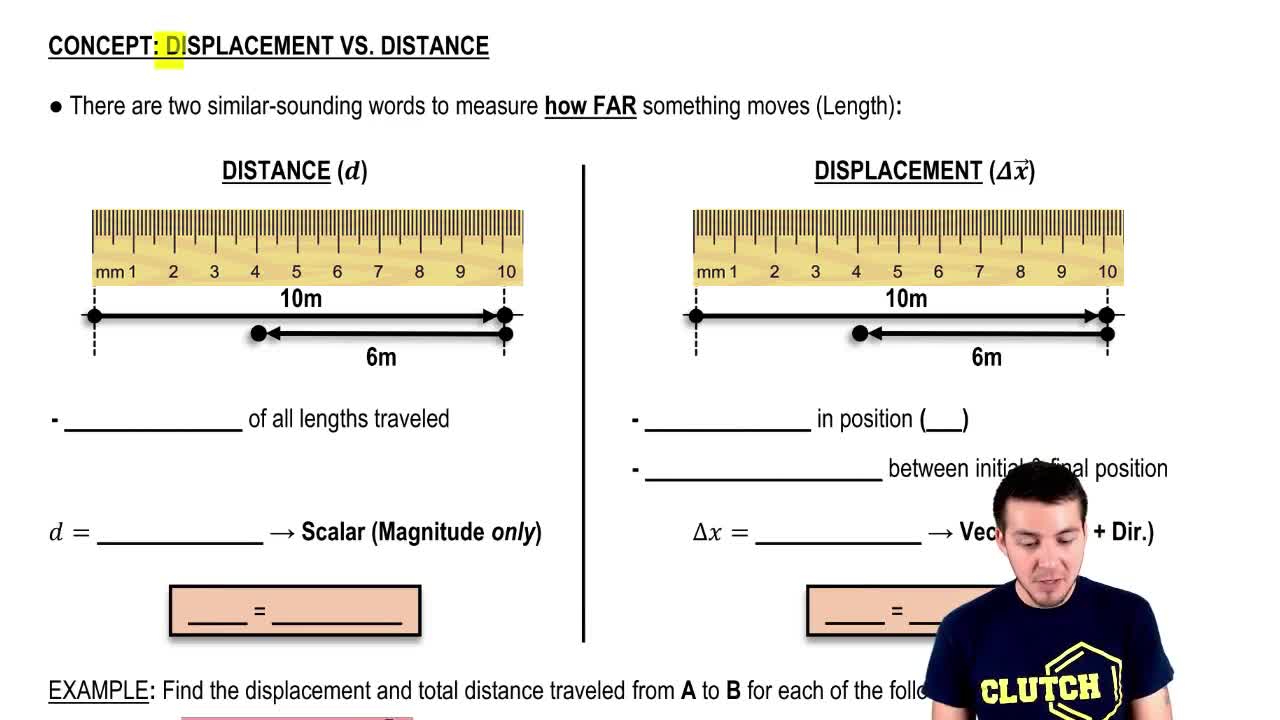
Displacement in Physics

Displacement is a vector quantity that refers to the change in position of an object. It is defined as the difference between the final and initial position vectors. In this problem, the displacement is crucial for determining the vertical component of the movement, which directly affects the work done by gravity as the compressor is dragged up the incline.
Recommended video:
Guided course
06:13
Displacement vs. Distance