Ch 09: Work and Kinetic Energy
Knight Calc - Physics for Scientists and Engineers 5th Edition
Knight Calc5th EditionPhysics for Scientists and EngineersISBN: 9780137344796Not the one you use?Change textbook
Chapter 9, Problem 1

At what speed does a 1000 kg compact car have the same kinetic energy as a 20,000 kg truck going 25 km/h?

Verified step by step guidance
1
Step 1: Recall the formula for kinetic energy, which is \( KE = \frac{1}{2} m v^2 \), where \( KE \) is the kinetic energy, \( m \) is the mass, and \( v \) is the velocity.
Step 2: Calculate the kinetic energy of the truck using its mass \( m = 20,000 \, \text{kg} \) and velocity \( v = 25 \, \text{km/h} \). First, convert the velocity from \( \text{km/h} \) to \( \text{m/s} \) using the conversion factor \( 1 \, \text{km/h} = \frac{1}{3.6} \, \text{m/s} \).
Step 3: Set the kinetic energy of the car equal to the kinetic energy of the truck. Use \( KE_{\text{car}} = KE_{\text{truck}} \), which translates to \( \frac{1}{2} m_{\text{car}} v_{\text{car}}^2 = \frac{1}{2} m_{\text{truck}} v_{\text{truck}}^2 \). Cancel out the \( \frac{1}{2} \) factor on both sides.
Step 4: Solve for the velocity of the car \( v_{\text{car}} \) by rearranging the equation: \( v_{\text{car}} = \sqrt{\frac{m_{\text{truck}}}{m_{\text{car}}} \cdot v_{\text{truck}}^2} \). Substitute \( m_{\text{truck}} = 20,000 \, \text{kg} \), \( m_{\text{car}} = 1,000 \, \text{kg} \), and \( v_{\text{truck}} \) in \( \text{m/s} \).
Step 5: Perform the square root operation to find the velocity of the car in \( \text{m/s} \). If needed, convert the result back to \( \text{km/h} \) using the factor \( 1 \, \text{m/s} = 3.6 \, \text{km/h} \).

Verified video answer for a similar problem:

This video solution was recommended by our tutors as helpful for the problem above.
Video duration:
4m
Was this helpful?

Key Concepts

Here are the essential concepts you must grasp in order to answer the question correctly.

Kinetic Energy

Kinetic energy is the energy an object possesses due to its motion, calculated using the formula KE = 1/2 mv², where m is the mass and v is the velocity. This concept is crucial for comparing the energy of different objects in motion, as it directly relates to both their mass and speed.
Recommended video:
Guided course
06:07
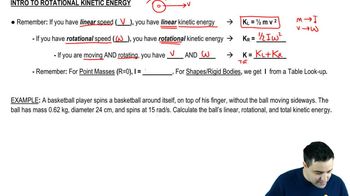
Intro to Rotational Kinetic Energy

Mass and Velocity Relationship

The relationship between mass and velocity is fundamental in understanding how kinetic energy varies with changes in these parameters. For two objects to have the same kinetic energy, adjustments in either mass or velocity must be made, illustrating the inverse relationship between mass and the square of velocity in the kinetic energy formula.
Recommended video:
Guided course
20:32
Mass Spectrometers

Unit Conversion

Unit conversion is essential when dealing with different measurement systems, such as converting kilometers per hour (km/h) to meters per second (m/s). This ensures consistency in calculations, particularly when comparing the kinetic energies of objects with different masses and speeds, as accurate units are necessary for correct results.
Recommended video:
Guided course
07:46
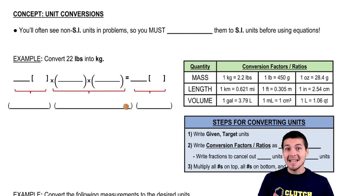
Unit Conversions