Ch 09: Work and Kinetic Energy
Knight Calc - Physics for Scientists and Engineers 5th Edition
Knight Calc5th EditionPhysics for Scientists and EngineersISBN: 9780137344796Not the one you use?Change textbook
Chapter 9, Problem 3

A mother has four times the mass of her young son. Both are running with the same kinetic energy. What is the ratio vson/vmother of their speeds?

Verified step by step guidance
1
Start by recalling the formula for kinetic energy: K=12mv2, where K is the kinetic energy, m is the mass, and v is the velocity.
Since the mother and son have the same kinetic energy, set their kinetic energy expressions equal to each other: 12mvsonv2=12(4m)vmotherv2, where the mother's mass is four times the son's mass.
Cancel out the common terms, such as 12 and m, from both sides of the equation. This simplifies to: vson2=4vmother2.
Take the square root of both sides to solve for the ratio of their speeds: vsonvmother=4.
Simplify the square root to find the ratio: vsonvmother=2. Thus, the son's speed is twice the mother's speed.

Verified video answer for a similar problem:

This video solution was recommended by our tutors as helpful for the problem above.
Video duration:
3m
Was this helpful?

Key Concepts

Here are the essential concepts you must grasp in order to answer the question correctly.

Kinetic Energy

Kinetic energy (KE) is the energy an object possesses due to its motion, calculated using the formula KE = 1/2 mv², where m is mass and v is velocity. In this scenario, both the mother and son have the same kinetic energy, which implies a relationship between their masses and velocities that can be analyzed to find their speed ratio.
Recommended video:
Guided course
06:07
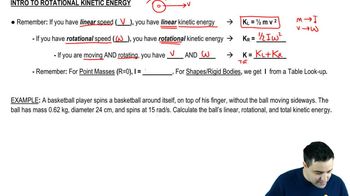
Intro to Rotational Kinetic Energy

Mass and Velocity Relationship

In physics, when two objects have the same kinetic energy, their masses and velocities are inversely related. Specifically, if one object has a greater mass, it must have a lower velocity to maintain the same kinetic energy as a lighter object. This principle is crucial for determining the speed ratio between the mother and son in the given problem.
Recommended video:
Guided course
20:32
Mass Spectrometers

Ratio of Speeds

The ratio of speeds (v(son)/v(mother)) can be derived from the relationship between their masses and kinetic energies. Since the mother has four times the mass of her son and both have equal kinetic energy, we can set up a proportion based on their kinetic energy equations to find the exact ratio of their speeds, illustrating how mass affects velocity in motion.
Recommended video:
Guided course
07:59
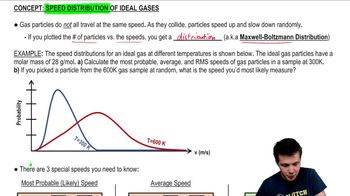
Speed Distribution & Special Speeds of Ideal Gases