
Ch 08: Dynamics II: Motion in a Plane
Knight Calc - Physics for Scientists and Engineers 5th Edition
Knight Calc5th EditionPhysics for Scientists and EngineersISBN: 9780137344796Not the one you use?Change textbook
Chapter 8, Problem 11

A 5.0 g coin is placed 15 cm from the center of a turntable. The coin has static and kinetic coefficients of friction with the turntable surface of μs = 0.80 and μk = 0.50. The turntable very slowly speeds up to 60 rpm. Does the coin slide off?

Verified step by step guidance
1
Step 1: Convert the turntable's rotational speed from revolutions per minute (rpm) to angular velocity in radians per second. Use the formula \( \omega = \frac{2\pi \times \text{rpm}}{60} \).
Step 2: Calculate the maximum static friction force \( F_{\text{friction,max}} \) using \( F_{\text{friction,max}} = \mu_s \cdot m \cdot g \), where \( \mu_s \) is the static coefficient of friction, \( m \) is the mass of the coin, and \( g \) is the acceleration due to gravity (\( 9.8 \, \text{m/s}^2 \)).
Step 3: Determine the centripetal force \( F_c \) required to keep the coin in circular motion using \( F_c = m \cdot r \cdot \omega^2 \), where \( r \) is the distance from the center of the turntable and \( \omega \) is the angular velocity.
Step 4: Compare the centripetal force \( F_c \) to the maximum static friction force \( F_{\text{friction,max}} \). If \( F_c > F_{\text{friction,max}} \), the coin will slide off; otherwise, it will stay in place.
Step 5: Conclude whether the coin slides off based on the comparison in Step 4. If the coin slides off, kinetic friction \( \mu_k \) will come into play, but for this problem, the focus is on whether static friction is sufficient to prevent sliding.

Verified video answer for a similar problem:

This video solution was recommended by our tutors as helpful for the problem above.
Video duration:
13m
Was this helpful?

Key Concepts

Here are the essential concepts you must grasp in order to answer the question correctly.

Friction

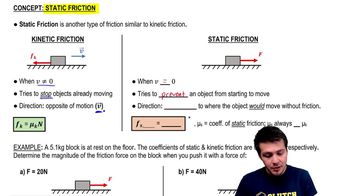
Friction is the force that opposes the relative motion of two surfaces in contact. It is characterized by two coefficients: static friction (μs), which prevents motion, and kinetic friction (μk), which acts when surfaces are sliding against each other. In this scenario, the static friction coefficient determines whether the coin will remain stationary on the turntable as it accelerates.
Recommended video:
Guided course
08:11
Static Friction & Equilibrium

Centripetal Force

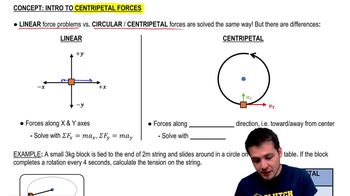
Centripetal force is the net force required to keep an object moving in a circular path, directed towards the center of the circle. For the coin on the turntable, this force is provided by the friction between the coin and the surface. If the required centripetal force exceeds the maximum static friction force, the coin will slide off.
Recommended video:
Guided course
06:48
Intro to Centripetal Forces

Angular Velocity

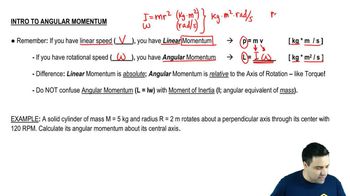
Angular velocity is a measure of how quickly an object rotates around a central point, expressed in radians per second or revolutions per minute (rpm). In this question, the turntable's speed of 60 rpm translates to a specific angular velocity, which influences the centripetal acceleration experienced by the coin. Understanding this relationship is crucial to determining if the coin will remain on the turntable.
Recommended video:
Guided course
06:18
Intro to Angular Momentum