Ch 08: Dynamics II: Motion in a Plane
Knight Calc - Physics for Scientists and Engineers 5th Edition
Knight Calc5th EditionPhysics for Scientists and EngineersISBN: 9780137344796Not the one you use?Change textbook
Chapter 8, Problem 8a

A 200 g block on a 50-cm-long string swings in a circle on a horizontal, frictionless table at 75 rpm. What is the speed of the block?

Verified step by step guidance
1
Convert the given mass of the block from grams to kilograms. Since 1 g = 0.001 kg, the mass of the block is \( m = 200 \times 0.001 \; \text{kg} \).
Convert the length of the string from centimeters to meters. Since 1 cm = 0.01 m, the length of the string is \( r = 50 \times 0.01 \; \text{m} \).
Convert the rotational speed from revolutions per minute (rpm) to angular velocity in radians per second. Use the formula \( \omega = \frac{2 \pi \; \text{rad}}{1 \; \text{rev}} \times \frac{75 \; \text{rev}}{60 \; \text{s}} \).
Relate the linear speed \( v \) of the block to the angular velocity \( \omega \) using the formula \( v = r \omega \), where \( r \) is the radius of the circular motion (equal to the length of the string).
Substitute the values of \( r \) and \( \omega \) into the formula \( v = r \omega \) to calculate the speed of the block.

Verified video answer for a similar problem:

This video solution was recommended by our tutors as helpful for the problem above.
Video duration:
1m
Was this helpful?

Key Concepts

Here are the essential concepts you must grasp in order to answer the question correctly.

Centripetal Force

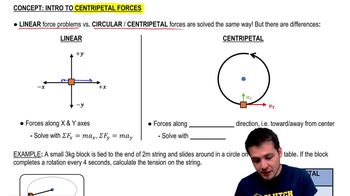
Centripetal force is the net force acting on an object moving in a circular path, directed towards the center of the circle. It is essential for maintaining circular motion and is provided by tension, gravity, or friction, depending on the scenario. In this case, the tension in the string provides the necessary centripetal force to keep the block moving in a circle.
Recommended video:
Guided course
06:48
Intro to Centripetal Forces

Linear Speed

Linear speed refers to the distance traveled by an object per unit of time. For an object moving in a circle, the linear speed can be calculated using the formula v = 2πr/T, where r is the radius of the circle and T is the period of rotation. In this problem, the speed of the block can be derived from its rotational speed in revolutions per minute (rpm) and the radius of the circular path.
Recommended video:
Guided course
07:31
Linear Thermal Expansion

Conversion of Units

Conversion of units is a critical skill in physics that involves changing a measurement from one unit to another to facilitate calculations. In this question, converting the block's rotational speed from revolutions per minute (rpm) to a linear speed in meters per second (m/s) is necessary for solving the problem. Understanding how to convert between different units ensures accurate results in calculations involving speed and distance.
Recommended video:
Guided course
07:46
Unit Conversions
Related Practice
Textbook Question

A 1500 kg car takes a 50-m-radius unbanked curve at 15 m/s. What is the size of the friction force on the car?

1
views

Textbook Question

A 200 g block on a 50-cm-long string swings in a circle on a horizontal, frictionless table at 75 rpm. What is the tension in the string?

1
views
1
rank
Textbook Question

Suppose the moon were held in its orbit not by gravity but by a massless cable attached to the center of the earth. What would be the tension in the cable? Use the table of astronomical data inside the back cover of the book.

1
views
Textbook Question

In the Bohr model of the hydrogen atom, an electron (mass m = 9.1 x 10⁻³¹ kg) orbits a proton at a distance of 5.3 x 10⁻¹¹ m. The proton pulls on the electron with an electric force of 8.2 x 10⁻⁸ N. How many revolutions per second does the electron make?

Textbook Question

A 5.0 g coin is placed 15 cm from the center of a turntable. The coin has static and kinetic coefficients of friction with the turntable surface of μs = 0.80 and μk = 0.50. The turntable very slowly speeds up to 60 rpm. Does the coin slide off?

2
views
Textbook Question

A 4.0 x 10¹⁰ kg asteroid is heading directly toward the center of the earth at a steady 20 km/s. To save the planet, astronauts strap a giant rocket to the asteroid perpendicular to its direction of travel. The rocket generates 5.0 x 10⁹ N of thrust. The rocket is fired when the asteroid is 4.0 x 10⁶ km away from earth. You can ignore the earth's gravitational force on the asteroid and their rotation about the sun.The radius of the earth is 6400 km. By what minimum angle must the asteroid be deflected to just miss the earth?

6
views