Ch 07: Newton's Third Law
Knight Calc - Physics for Scientists and Engineers 5th Edition
Knight Calc5th EditionPhysics for Scientists and EngineersISBN: 9780137344796Not the one you use?Change textbook
Chapter 7, Problem 1c

A tennis racket swung over the server's head hits a tennis ball horizontally. Draw a free-body diagram for each object in the system. Use dashed lines to connect members of an action/reaction pair.

Verified step by step guidance
1
Step 1: Identify the objects in the system. In this case, the objects are the tennis racket and the tennis ball. Each object will have its own free-body diagram.
Step 2: For the tennis racket, draw a free-body diagram. Represent the forces acting on it: (1) the gravitational force acting downward (\( F_g = m_r g \), where \( m_r \) is the mass of the racket), and (2) the upward normal force exerted by the server's hand. If the racket is in motion, include the force exerted by the ball on the racket (action/reaction pair).
Step 3: For the tennis ball, draw a free-body diagram. Represent the forces acting on it: (1) the gravitational force acting downward (\( F_g = m_b g \), where \( m_b \) is the mass of the ball), and (2) the horizontal force exerted by the racket on the ball during the hit (action/reaction pair).
Step 4: Use dashed lines to connect the action/reaction force pairs. For example, the force exerted by the racket on the ball and the force exerted by the ball on the racket are equal in magnitude and opposite in direction, as per Newton's Third Law. Connect these forces with a dashed line.
Step 5: Ensure that the diagrams are labeled clearly with all forces identified. For each force, indicate its direction and label it appropriately (e.g., \( F_g \) for gravitational force, \( F_{r \, on \, b} \) for the force of the racket on the ball, etc.). This will help in understanding the interaction between the objects in the system.

Verified video answer for a similar problem:

This video solution was recommended by our tutors as helpful for the problem above.
Was this helpful?

Key Concepts

Here are the essential concepts you must grasp in order to answer the question correctly.

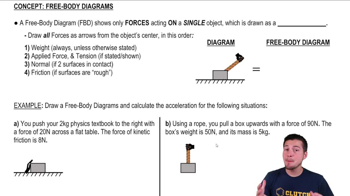
Free-Body Diagram

A free-body diagram is a graphical representation used to visualize the forces acting on an object. It shows the object as a dot and the forces as arrows pointing away from the object, indicating both the direction and magnitude of each force. This tool is essential for analyzing the dynamics of a system, as it helps identify all the forces involved, including gravitational, normal, frictional, and applied forces.
Recommended video:
Guided course
08:42
Free-Body Diagrams

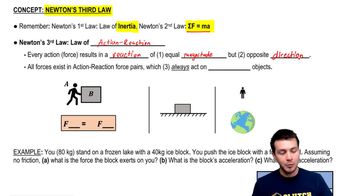
Newton's Third Law of Motion

Newton's Third Law states that for every action, there is an equal and opposite reaction. This principle implies that forces always occur in pairs; when one object exerts a force on another, the second object exerts a force of equal magnitude and opposite direction back on the first. Understanding this law is crucial for identifying action/reaction pairs in the free-body diagrams of the tennis racket and ball.
Recommended video:
Guided course
08:01
Newton's Third Law & Action-Reaction Pairs

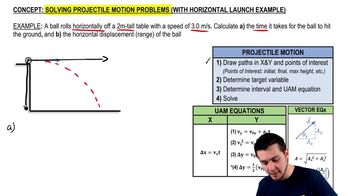
Horizontal Motion

Horizontal motion refers to movement along a horizontal plane, where the primary forces acting on an object are typically gravity and any applied forces. In the context of the tennis racket hitting the ball, the ball's horizontal motion is influenced by the force exerted by the racket and air resistance. Analyzing horizontal motion is important for understanding the trajectory and behavior of the ball after impact.
Recommended video:
Guided course
08:37
Solving Horizontal Launch Problems