Ch 07: Newton's Third Law
Knight Calc - Physics for Scientists and Engineers 5th Edition
Knight Calc5th EditionPhysics for Scientists and EngineersISBN: 9780137344796Not the one you use?Change textbook
Chapter 7, Problem 3a

A heavy steel cable attached to a motor is lifting a girder. The girder is speeding up. Draw an interaction diagram.

Verified step by step guidance
1
Step 1: Identify the objects involved in the scenario. In this case, the objects are the steel cable, the motor, and the girder. These are the key components of the system interacting with each other.
Step 2: Determine the forces acting on the girder. The girder experiences the upward tension force exerted by the steel cable and the downward gravitational force due to its weight. Represent these forces clearly in the diagram.
Step 3: Consider the steel cable. The cable is under tension due to the motor pulling it upward and the girder's weight pulling it downward. Include these forces in the interaction diagram.
Step 4: Account for the motor's role. The motor applies a force to the steel cable, causing it to lift the girder. This force is responsible for the girder's acceleration. Represent this interaction in the diagram.
Step 5: Draw the interaction diagram. Use arrows to represent forces and label them appropriately (e.g., tension, weight). Indicate the direction of acceleration for the girder, showing that it is speeding up as it moves upward.

Verified video answer for a similar problem:

This video solution was recommended by our tutors as helpful for the problem above.
Video duration:
2m
Was this helpful?

Key Concepts

Here are the essential concepts you must grasp in order to answer the question correctly.

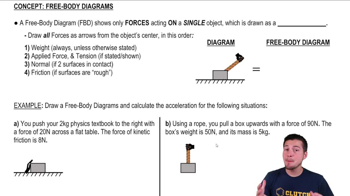
Free Body Diagram

A free body diagram (FBD) is a graphical representation used to visualize the forces acting on an object. In this context, it helps identify the forces acting on the girder as it is lifted, including tension from the cable and gravitational force. Understanding FBDs is crucial for analyzing the dynamics of the system and determining the net force acting on the girder.
Recommended video:
Guided course
08:42
Free-Body Diagrams

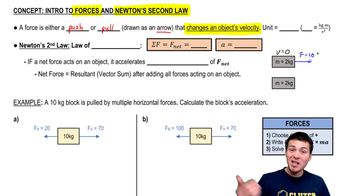
Newton's Second Law of Motion

Newton's Second Law states that the acceleration of an object is directly proportional to the net force acting on it and inversely proportional to its mass, expressed as F = ma. This principle is essential for understanding why the girder is speeding up; the net force (tension minus weight) results in a positive acceleration. This law provides the foundation for analyzing the motion of the girder as it is lifted.
Recommended video:
Guided course
06:54
Intro to Forces & Newton's Second Law

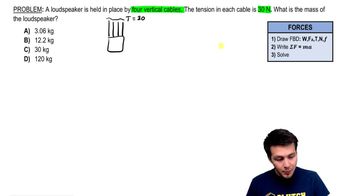
Tension in a Cable

Tension is the force transmitted through a cable or rope when it is pulled tight by forces acting from opposite ends. In this scenario, the tension in the steel cable is responsible for lifting the girder against the force of gravity. Understanding how tension varies with the acceleration of the girder is key to accurately drawing the interaction diagram and analyzing the forces involved.
Recommended video:
Guided course
03:25
Multiple Cables on a Loudspeaker