Ch 05: Force and Motion
Knight Calc - Physics for Scientists and Engineers 5th Edition
Knight Calc5th EditionPhysics for Scientists and EngineersISBN: 9780137344796Not the one you use?Change textbook
Chapter 5, Problem 24

Exercises 23, 24, 25, 26, and 27 describe a situation. For each, identify all forces acting on the object and draw a free-body diagram of the object. An ice hockey puck glides across frictionless ice.

Verified step by step guidance
1
Step 1: Identify the object in question. In this case, the object is the ice hockey puck gliding across frictionless ice.
Step 2: Recognize the key condition of the problem: the ice is frictionless. This means there is no force of friction acting on the puck.
Step 3: Determine the forces acting on the puck. The two primary forces are: (1) the gravitational force acting downward, represented as \( F_g = m \cdot g \), where \( m \) is the mass of the puck and \( g \) is the acceleration due to gravity, and (2) the normal force exerted by the ice surface acting upward, which balances the gravitational force.
Step 4: Note that since the puck is gliding and no external horizontal forces are mentioned, there are no horizontal forces acting on the puck. Its motion is governed by inertia, as per Newton's First Law.
Step 5: Draw the free-body diagram. Represent the puck as a dot or small rectangle. Draw an arrow pointing downward labeled \( F_g \) (gravitational force) and an arrow pointing upward labeled \( F_N \) (normal force). Ensure the lengths of the arrows are equal to indicate that the forces are balanced.

Verified video answer for a similar problem:

This video solution was recommended by our tutors as helpful for the problem above.
Video duration:
2m
Was this helpful?

Key Concepts

Here are the essential concepts you must grasp in order to answer the question correctly.

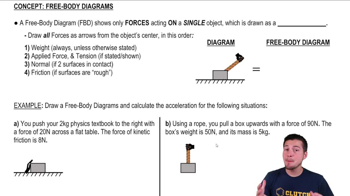
Free-Body Diagram

A free-body diagram is a graphical representation used to visualize the forces acting on an object. It typically includes the object in question, represented as a dot or a box, and arrows indicating the direction and magnitude of each force. This tool helps in analyzing the net force and understanding the motion of the object based on Newton's laws.
Recommended video:
Guided course
08:42
Free-Body Diagrams

Forces Acting on an Object

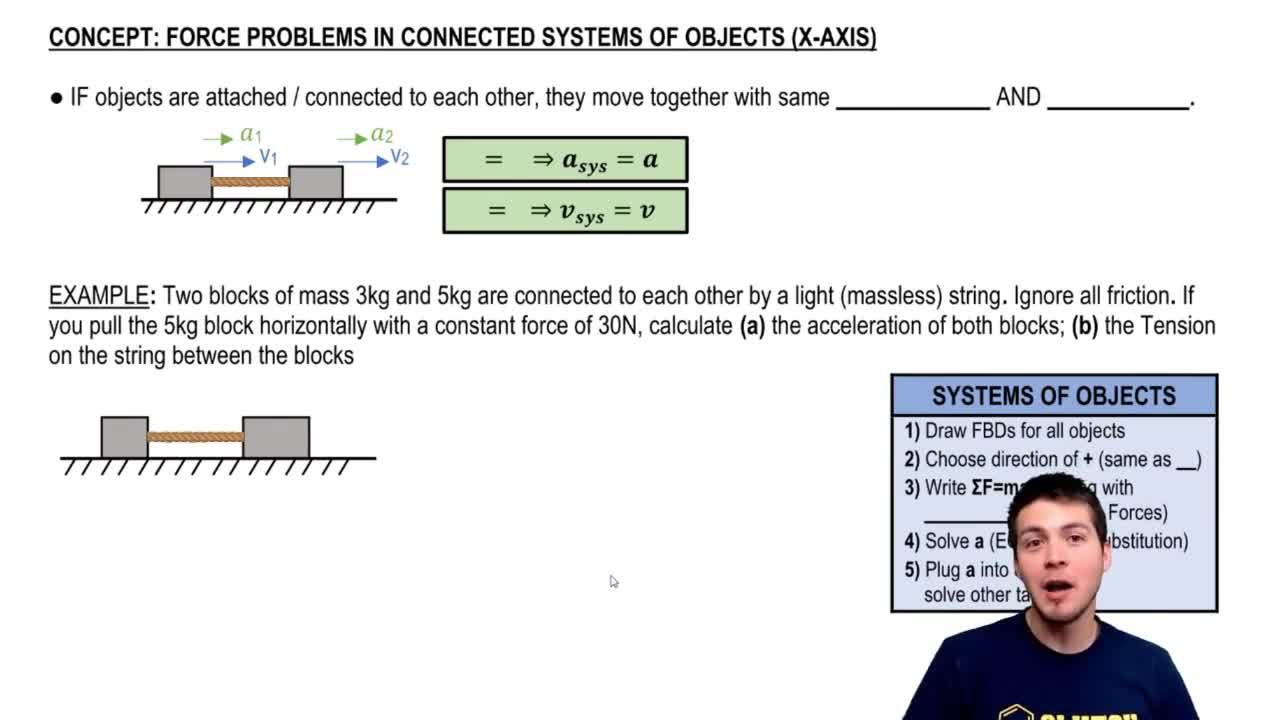
Forces are interactions that can cause an object to accelerate, decelerate, or change direction. In the case of the ice hockey puck, the primary forces to consider are gravitational force acting downward and the normal force acting upward from the ice surface. Since the ice is frictionless, there are no frictional forces opposing the puck's motion.
Recommended video:
Guided course
09:12
Solving Force Problems in Connected Systems of Objects

Newton's First Law of Motion

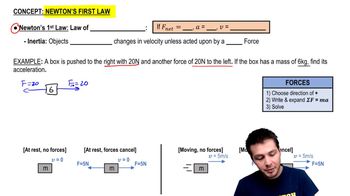
Newton's First Law states that an object at rest will remain at rest, and an object in motion will continue in motion with the same speed and in the same direction unless acted upon by a net external force. This principle is crucial for understanding the behavior of the hockey puck as it glides across the ice, indicating that it will maintain its state of motion until a force, such as friction or a collision, acts on it.
Recommended video:
Guided course
04:46
Newton's 1st Law