Ch 04: Kinematics in Two Dimensions
Knight Calc - Physics for Scientists and Engineers 5th Edition
Knight Calc5th EditionPhysics for Scientists and EngineersISBN: 9780137344796Not the one you use?Change textbook
Chapter 4, Problem 22

Susan, driving north at 60 mph, and Trent, driving east at 45 mph, are approaching an intersection. What is Trent's speed relative to Susan's reference frame?

Verified step by step guidance
1
Define the problem in terms of relative velocity. The relative velocity of Trent with respect to Susan is the vector difference between Trent's velocity and Susan's velocity: \( \vec{v}_{TS} = \vec{v}_T - \vec{v}_S \).
Express the velocities of Susan and Trent in vector form. Since Susan is driving north at 60 mph, her velocity vector is \( \vec{v}_S = 60 \hat{j} \) (where \( \hat{j} \) represents the northward direction). Trent is driving east at 45 mph, so his velocity vector is \( \vec{v}_T = 45 \hat{i} \) (where \( \hat{i} \) represents the eastward direction).
Subtract Susan's velocity vector from Trent's velocity vector to find the relative velocity: \( \vec{v}_{TS} = \vec{v}_T - \vec{v}_S = 45 \hat{i} - 60 \hat{j} \).
Calculate the magnitude of the relative velocity vector using the Pythagorean theorem: \( |\vec{v}_{TS}| = \sqrt{(45)^2 + (-60)^2} \).
Interpret the result. The magnitude \( |\vec{v}_{TS}| \) represents Trent's speed relative to Susan's reference frame, and the direction can be determined using trigonometry if needed.

Verified video answer for a similar problem:

This video solution was recommended by our tutors as helpful for the problem above.
Video duration:
4m
Was this helpful?

Key Concepts

Here are the essential concepts you must grasp in order to answer the question correctly.

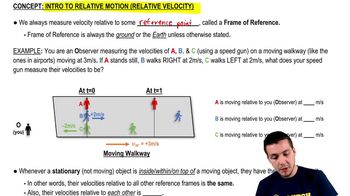
Relative Velocity

Relative velocity is the velocity of one object as observed from another object's frame of reference. It is calculated by subtracting the velocity vector of the observer from the velocity vector of the object being observed. In this case, to find Trent's speed relative to Susan, we need to consider both their velocities and the direction they are traveling.
Recommended video:
Guided course
04:27
Intro to Relative Motion (Relative Velocity)

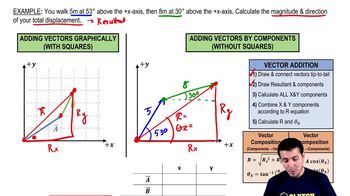
Vector Addition

Vector addition is a mathematical operation used to combine two or more vectors to determine a resultant vector. In the context of relative velocity, this involves adding the velocity vectors of Susan and Trent, taking into account their directions. Since they are traveling at right angles to each other, the Pythagorean theorem is often used to find the magnitude of the resultant vector.
Recommended video:
Guided course
07:30
Vector Addition By Components

Pythagorean Theorem

The Pythagorean theorem is a fundamental principle in geometry that relates the lengths of the sides of a right triangle. It states that the square of the hypotenuse (the side opposite the right angle) is equal to the sum of the squares of the other two sides. In this scenario, it helps calculate the resultant speed of Trent as observed from Susan's perspective, as their paths form a right triangle.
Recommended video:
Guided course
13:46
Parallel Axis Theorem