Ch 04: Kinematics in Two Dimensions
Knight Calc - Physics for Scientists and Engineers 5th Edition
Knight Calc5th EditionPhysics for Scientists and EngineersISBN: 9780137344796Not the one you use?Change textbook
Chapter 4, Problem 21b

A kayaker needs to paddle north across a 100-m-wide harbor. The tide is going out, creating a tidal current that flows to the east at 2.0 m/s. The kayaker can paddle with a speed of 3.0 m/s. How long will it take him to cross?

Verified step by step guidance
1
Step 1: Recognize that the kayaker's motion is influenced by two components: the northward paddling velocity and the eastward tidal current. The kayaker's paddling speed is 3.0 m/s, and the tidal current flows east at 2.0 m/s. To determine the time to cross, focus only on the northward motion since the width of the harbor is given as 100 m.
Step 2: The kayaker's northward velocity is the component of his paddling speed directed perpendicular to the tidal current. Since the kayaker must paddle at an angle to counteract the eastward current, the northward velocity can be calculated using trigonometry. The northward velocity is given by \( v_{north} = v_{kayaker} \cdot \cos(\theta) \), where \( \theta \) is the angle the kayaker paddles relative to the north direction.
Step 3: To counteract the eastward current, the kayaker must paddle at an angle such that the eastward component of his paddling velocity cancels the tidal current. This condition is expressed as \( v_{kayaker} \cdot \sin(\theta) = v_{current} \). Solve for \( \sin(\theta) \) using \( \sin(\theta) = \frac{v_{current}}{v_{kayaker}} \). Substitute \( v_{current} = 2.0 \, \text{m/s} \) and \( v_{kayaker} = 3.0 \, \text{m/s} \) to find \( \sin(\theta) \).
Step 4: Use the Pythagorean identity \( \sin^2(\theta) + \cos^2(\theta) = 1 \) to calculate \( \cos(\theta) \). Substitute \( \sin(\theta) \) from Step 3 into the identity to find \( \cos(\theta) \). Then, calculate the northward velocity \( v_{north} \) using \( v_{north} = v_{kayaker} \cdot \cos(\theta) \).
Step 5: Once \( v_{north} \) is determined, calculate the time to cross the harbor using the formula \( t = \frac{d}{v_{north}} \), where \( d = 100 \, \text{m} \) is the width of the harbor. Substitute \( v_{north} \) into the equation to find the time required for the kayaker to cross.

Verified video answer for a similar problem:

This video solution was recommended by our tutors as helpful for the problem above.
Video duration:
11m
Was this helpful?

Key Concepts

Here are the essential concepts you must grasp in order to answer the question correctly.

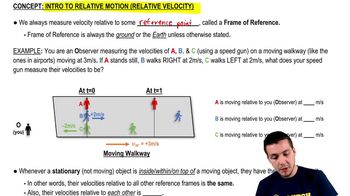
Relative Velocity

Relative velocity is the velocity of an object as observed from a particular reference frame. In this scenario, the kayaker's velocity must be analyzed in relation to the tidal current. The effective velocity of the kayaker across the harbor will be the vector sum of his paddling speed and the current's speed, which affects his overall path.
Recommended video:
Guided course
04:27
Intro to Relative Motion (Relative Velocity)

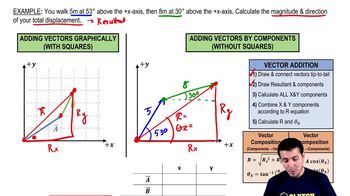
Vector Addition

Vector addition is the process of combining two or more vectors to determine a resultant vector. In this case, the kayaker's velocity vector (3.0 m/s north) and the current's velocity vector (2.0 m/s east) must be added to find the resultant velocity. This involves using the Pythagorean theorem to calculate the magnitude and direction of the resultant vector.
Recommended video:
Guided course
07:30
Vector Addition By Components

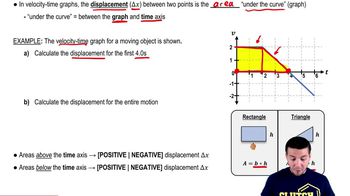
Time Calculation

Time calculation in physics often involves using the formula time = distance / speed. Once the effective speed of the kayaker across the harbor is determined, this formula can be applied to find the time it takes to cross the 100-meter width. Understanding how to manipulate this formula is essential for solving problems involving motion.
Recommended video:
Guided course
04:43
Calculating Displacement from Velocity-Time Graphs