
A runner is training for an upcoming marathon by running around a 100-m-diameter circular track at constant speed. Let a coordinate system have its origin at the center of the circle with the x-axis pointing east and the y-axis north. The runner starts at (x,y) = (50m, 0m) and runs 2.5 times around the track in aclockwise direction. What is his displacement vector? Give your answer as a magnitude and direction.
Ch 03: Vectors and Coordinate Systems
Knight Calc5th EditionPhysics for Scientists and EngineersISBN: 9780137344796Not the one you use?Change textbook
Chapter 3, Problem 8
Let C = (3.15 m, 15 degrees above the neagtive x-axis) and D = (25.6, 30 degrees to the right of the negative y-axis). Find the x and y components of each vector.
Verified step by step guidance1
Step 1: Understand the problem. You are tasked with finding the x and y components of two vectors, C and D, given their magnitudes and angles relative to specific axes. Recall that the components of a vector can be calculated using trigonometric functions: cosine for the x-component and sine for the y-component.
Step 2: For vector C, note that its magnitude is 3.15 m and its angle is 15 degrees above the negative x-axis. To find the x-component, use the formula: x_C = magnitude_C × cos(angle_C). Since the angle is above the negative x-axis, the x-component will be negative. For the y-component, use the formula: y_C = magnitude_C × sin(angle_C). The y-component will be positive because the vector points upward.
Step 3: For vector D, note that its magnitude is 25.6 m and its angle is 30 degrees to the right of the negative y-axis. To find the x-component, use the formula: x_D = magnitude_D × sin(angle_D). The x-component will be positive because the vector points to the right. For the y-component, use the formula: y_D = magnitude_D × cos(angle_D). The y-component will be negative because the vector points downward.
Step 4: Substitute the given values into the formulas. For vector C: x_C = 3.15 × cos(15°) and y_C = 3.15 × sin(15°). For vector D: x_D = 25.6 × sin(30°) and y_D = 25.6 × cos(30°). Ensure you use the correct trigonometric functions and account for the signs of the components based on the directions of the vectors.
Step 5: Perform the calculations using a calculator or software to find the numerical values of the components. Remember to keep track of the signs for each component based on the orientation of the vectors relative to the axes.

Verified video answer for a similar problem:
This video solution was recommended by our tutors as helpful for the problem above.
Video duration:
7mWas this helpful?
Key Concepts
Here are the essential concepts you must grasp in order to answer the question correctly.
Vector Components
Vector components are the projections of a vector along the axes of a coordinate system, typically the x and y axes. Each vector can be broken down into its horizontal (x) and vertical (y) components using trigonometric functions. For a vector with magnitude and angle, the x-component is found using cosine, while the y-component is found using sine.
Recommended video:
Guided course
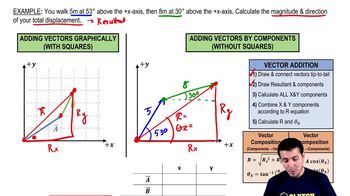
Vector Addition By Components
Trigonometric Functions
Trigonometric functions, such as sine and cosine, relate the angles of a triangle to the ratios of its sides. In the context of vectors, these functions are used to calculate the components of a vector based on its angle and magnitude. For example, if a vector makes an angle θ with the x-axis, the x-component is given by the product of the vector's magnitude and cos(θ), while the y-component is given by the product of the magnitude and sin(θ).
Recommended video:
Guided course
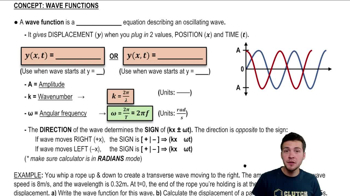
Intro to Wave Functions
Coordinate System Orientation
Understanding the orientation of the coordinate system is crucial for accurately determining vector components. In this case, angles are measured from specific axes, such as the negative x-axis and negative y-axis. This requires careful attention to the direction of the angles, as they can affect the signs of the resulting components, which can be positive or negative depending on the quadrant in which the vector lies.
Recommended video:
Guided course
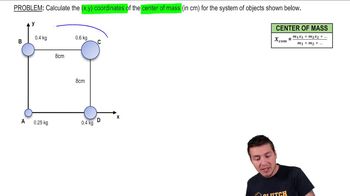
Coordinates of Center of Mass of 4 objects
Related Practice
Textbook Question
1
views
Textbook Question
Draw each of the following vectors. Then find its x- and y-components.
1
views
Textbook Question
Draw each of the following vectors. Then find its x- and y-components. v = (7.5 m/s, 30 degrees clockwise from the positive y-axis)
1
views
Textbook Question
Draw each of the following vectors. Then find its x- and y-components. F = (50.0 N, 36.9 degrees counterclockwise from the positive y-axis)
3
views
Textbook Question
Draw each of the following vectors, label an angle that specifies the vector's direction, and then find the vector's magnitude and direction. A = 3.0i + 7.0j
1
views
Textbook Question
Draw each of the following vectors, label an angle that specifies the vector's direction, and then find the vector's magnitude and direction. v = (14i - 11j) m/s
1
views
