Ch 03: Vectors and Coordinate Systems
Knight Calc - Physics for Scientists and Engineers 5th Edition
Knight Calc5th EditionPhysics for Scientists and EngineersISBN: 9780137344796Not the one you use?Change textbook
Chapter 3, Problem 7a

Draw each of the following vectors. Then find its x- and y-components. v = (7.5 m/s, 30 degrees clockwise from the positive y-axis)

Verified step by step guidance
1
Step 1: Understand the problem. The vector v has a magnitude of 7.5 m/s and is oriented 30 degrees clockwise from the positive y-axis. We need to find its x- and y-components using trigonometric functions.
Step 2: Define the coordinate system. Since the angle is measured clockwise from the positive y-axis, the x-component will be positive (to the right), and the y-component will be negative (downward).
Step 3: Use trigonometric functions to find the components. The x-component of the vector can be calculated using the formula: v x = v ⋅ sin(θ), where θ = 30 degrees. Similarly, the y-component can be calculated using: v y = v ⋅ cos(θ).
Step 4: Substitute the given values into the formulas. For the x-component: v x = 7.5 ⋅ sin(30°). For the y-component: v y = 7.5 ⋅ cos(30°).
Step 5: Simplify the trigonometric expressions. Use the known values of sin(30°) = 0.5 and cos(30°) = √3/2 to simplify the components. This will give you the x- and y-components of the vector.

Verified video answer for a similar problem:

This video solution was recommended by our tutors as helpful for the problem above.
Video duration:
2m
Was this helpful?

Key Concepts

Here are the essential concepts you must grasp in order to answer the question correctly.

Vectors

Vectors are quantities that have both magnitude and direction. In physics, they are often represented graphically as arrows, where the length of the arrow indicates the magnitude and the direction of the arrow indicates the direction of the vector. Understanding vectors is essential for analyzing motion and forces in two or three dimensions.
Recommended video:
Guided course
06:44
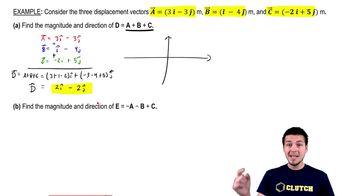
Adding 3 Vectors in Unit Vector Notation

Components of a Vector

The components of a vector are the projections of that vector along the axes of a coordinate system, typically the x-axis and y-axis. For a vector given in polar form, such as its magnitude and angle, the components can be calculated using trigonometric functions: the x-component is found using cosine, and the y-component using sine. This breakdown allows for easier calculations in physics problems.
Recommended video:
Guided course
07:30
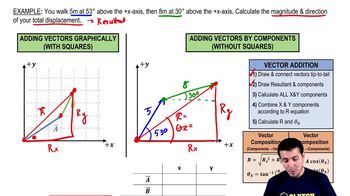
Vector Addition By Components

Trigonometry in Physics

Trigonometry is a branch of mathematics that deals with the relationships between the angles and sides of triangles. In physics, it is used to resolve vectors into their components and to analyze periodic phenomena. The sine and cosine functions are particularly important for converting between polar coordinates (magnitude and angle) and Cartesian coordinates (x and y components).
Recommended video:
Guided course
3:26
Trigonometry