
A crate, seen from above, is pulled with three ropes that have the tensions shown in FIGURE P3.44. Tension is a vector directed along the rope, measured in newtons (abbreviated N). Suppose the three ropes are replaced with a single rope that has exactly the same effect on the crate. What is the tension in this rope? Write your answer in component form using unit vectors.
Ch 03: Vectors and Coordinate Systems
Knight Calc5th EditionPhysics for Scientists and EngineersISBN: 9780137344796Not the one you use?Change textbook
Chapter 3, Problem 46
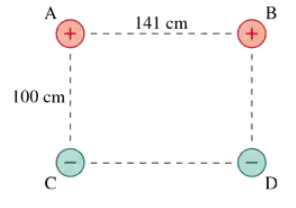
FIGURE P3.46 shows four electric charges located at the corners of a rectangle. Like charges, you will recall, repel each other while opposite charges attract. Charge B exerts a repulsive force (directly away from B) on charge A of 3.0 N. Charge C exerts an attractive force (directly toward C) on charge A of 6.0 N. Finally, charge D exerts an attractive force of 2.0 N on charge A. Assuming that forces are vectors, what are the magnitude and direction of the net force Fnet exerted on charge A?

Verified step by step guidance1
Step 1: Understand the problem and identify the forces acting on charge A. There are three forces: a repulsive force of 3.0 N from charge B, an attractive force of 6.0 N from charge C, and an attractive force of 2.0 N from charge D. These forces are vectors, so their directions and magnitudes must be considered.
Step 2: Break each force into its components. Use trigonometry to resolve the forces into x and y components. For example, if the rectangle's dimensions are given, use the geometry to determine the angles of the forces relative to the axes. Let F_B, F_C, and F_D represent the forces from charges B, C, and D, respectively.
Step 3: Write the components of each force. For F_B (3.0 N), determine its x and y components using the angle it makes with the axes. Similarly, resolve F_C (6.0 N) and F_D (2.0 N) into their respective x and y components. Use the formulas: F_x = F * cos(θ) and F_y = F * sin(θ), where θ is the angle of the force.
Step 4: Add the x and y components of all forces to find the net force components. Sum all x components to get F_net_x and all y components to get F_net_y. These are the components of the net force acting on charge A.
Step 5: Calculate the magnitude and direction of the net force. Use the Pythagorean theorem to find the magnitude: F_net = sqrt(F_net_x^2 + F_net_y^2). To find the direction, calculate the angle θ_net using the formula: θ_net = arctan(F_net_y / F_net_x). Ensure the angle is expressed relative to the correct axis based on the quadrant of the net force vector.

Verified video answer for a similar problem:
This video solution was recommended by our tutors as helpful for the problem above.
Video duration:
12mWas this helpful?
Key Concepts
Here are the essential concepts you must grasp in order to answer the question correctly.
Coulomb's Law
Coulomb's Law describes the electrostatic force between two charged objects. It states that the force is directly proportional to the product of the magnitudes of the charges and inversely proportional to the square of the distance between them. This law helps in calculating the forces exerted by charges on one another, determining whether they attract or repel based on their signs.
Recommended video:
Guided course
Coulomb's Law
Vector Addition
Vector addition is the process of combining multiple vectors to determine a resultant vector. In the context of forces, each force acting on an object can be represented as a vector with both magnitude and direction. The net force is found by adding these vectors, taking into account their directions, which may involve breaking them into components along the x and y axes.
Recommended video:
Guided course
Vector Addition By Components
Net Force
The net force is the vector sum of all individual forces acting on an object. It determines the object's acceleration and motion according to Newton's second law of motion. In this scenario, calculating the net force on charge A involves considering the magnitudes and directions of the forces exerted by charges B, C, and D, leading to a comprehensive understanding of the overall effect on charge A.
Recommended video:
Guided course
Finding Net Forces in 2D Gravitation
Related Practice
Textbook Question
1
views
Textbook Question
FIGURE P3.43 shows three ropes tied together in a knot. One of your friends pulls on a rope with 3.0 units of force and another pulls on a second rope with 5.0 units of force. How hard and in what direction must you pull on the third rope to keep the knot from moving? Give the direction as an angle below the negative x-axis.
1
views
Textbook Question
Four forces are exerted on the object shown in FIGURE . (Forces are measured in newtons, abbreviated .) The net force on the object is . What are (a) and (b) ? Give your answers in component form.
3
views
