
Ch 03: Vectors and Coordinate Systems
Knight Calc - Physics for Scientists and Engineers 5th Edition
Knight Calc5th EditionPhysics for Scientists and EngineersISBN: 9780137344796Not the one you use?Change textbook
Chapter 3, Problem 43

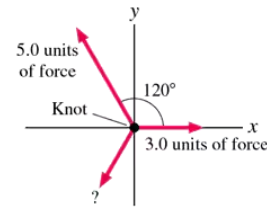
FIGURE P3.43 shows three ropes tied together in a knot. One of your friends pulls on a rope with 3.0 units of force and another pulls on a second rope with 5.0 units of force. How hard and in what direction must you pull on the third rope to keep the knot from moving? Give the direction as an angle below the negative x-axis.

Verified step by step guidance
1
Step 1: Break down the forces into their x and y components. For the first student pulling with 4.0 N at an angle of 60° above the positive x-axis, calculate the x-component using the formula Fₓ = F * cos(θ) and the y-component using Fᵧ = F * sin(θ). For the second student pulling with 6.0 N along the negative x-axis, the x-component is -6.0 N and the y-component is 0 N.
Step 2: Add the x-components of the forces from the first and second students to find the total x-component of the force acting on the knot. Similarly, add the y-components of the forces from the first and second students to find the total y-component of the force acting on the knot.
Step 3: To keep the knot stationary, the third student's force must exactly cancel out the resultant force from the first and second students. This means the third student's x-component must be equal in magnitude but opposite in sign to the total x-component, and the y-component must be equal in magnitude but opposite in sign to the total y-component.
Step 4: Use the Pythagorean theorem to calculate the magnitude of the third student's force. The formula is F = √(Fₓ² + Fᵧ²), where Fₓ and Fᵧ are the x and y components of the third student's force.
Step 5: Determine the direction of the third student's force. Use the formula θ = arctan(Fᵧ / Fₓ) to calculate the angle, and adjust the angle to be below the negative x-axis as specified in the problem.

Verified video answer for a similar problem:

This video solution was recommended by our tutors as helpful for the problem above.
Video duration:
6m
Was this helpful?

Key Concepts

Here are the essential concepts you must grasp in order to answer the question correctly.

Vector Addition

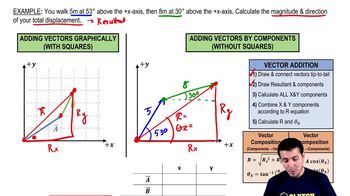
Vector addition is the process of combining two or more vectors to determine a resultant vector. This involves adding the magnitudes and directions of the vectors, typically using graphical methods or mathematical calculations. In this scenario, the forces exerted by the first two students must be combined to find the necessary force and direction for the third student to maintain equilibrium.
Recommended video:
Guided course
07:30
Vector Addition By Components

Equilibrium

Equilibrium occurs when the net force acting on an object is zero, meaning all forces balance each other out. In the context of this problem, the forces applied by the three students must sum to zero to keep the knot stationary. This principle is crucial for determining the magnitude and direction of the force the third student must apply.
Recommended video:
Guided course
10:13
Torque & Equilibrium

Trigonometry in Physics

Trigonometry is essential in physics for analyzing forces, especially when dealing with angles. It allows us to resolve forces into their components along the x and y axes. In this problem, the angles given for the forces applied by the first two students will be used to calculate their components, which will then help in determining the required force and angle for the third student.
Recommended video:
Guided course
3:26
Trigonometry
Related Practice
Textbook Question

A crate, seen from above, is pulled with three ropes that have the tensions shown in FIGURE P3.44. Tension is a vector directed along the rope, measured in newtons (abbreviated N). Suppose the three ropes are replaced with a single rope that has exactly the same effect on the crate. What is the tension in this rope? Write your answer in component form using unit vectors.

1
views
Textbook Question

Tom is climbing a 3.0-m-long ladder that leans against a vertical wall, contacting the wall 2.5 m above the ground. His weight of 680 N is a vector pointing vertically downward. (Weight is measured in newtons, abbreviated N.) What are the components of Tom's weight parallel and perpendicular to the ladder?

2
views
Textbook Question

FIGURE P3.46 shows four electric charges located at the corners of a rectangle. Like charges, you will recall, repel each other while opposite charges attract. Charge B exerts a repulsive force (directly away from B) on charge A of 3.0 N. Charge C exerts an attractive force (directly toward C) on charge A of 6.0 N. Finally, charge D exerts an attractive force of 2.0 N on charge A. Assuming that forces are vectors, what are the magnitude and direction of the net force Fnet exerted on charge A?

Textbook Question

The bacterium E. coli is a single-cell organism that lives in the gut of healthy animals, including humans. When grown in a uniform medium in the laboratory, these bacteria swim along zig-zag paths at a constant speed of 20 μm/s. FIGURE P3.42 shows the trajectory of an E. coli as it moves from point A to point E. What are the magnitude and direction of the bacterium's average velocity for the entire trip?

1
views
Textbook Question

The treasure map in FIGURE P3.41 gives the following directions to the buried treasure: 'Start at the old oak tree, walk due north for 500 paces, then due east for 100 paces. Dig.' But when you arrive, you find an angry dragon just north of the tree. To avoid the dragon, you set off along the yellow brick road at an angle 60° east of north. After walking 300 paces you see an opening through the woods. In which direction should you walk, as an angle west of north, and how far, to reach the treasure?

1
views
Textbook Question

Four forces are exerted on the object shown in FIGURE P3.45P3.45. (Forces are measured in newtons, abbreviated N\(\text{N}\).) The net force on the object is Fnet=F1+F2+F3+F4=4.0i^N\(\vec{F}\)_{\(\text{net}\)}=\(\vec{F}\)_1+\(\vec{F}\)_2+\(\vec{F}\)_3+\(\vec{F}\)_4=4.0\,\(\hat{\mathbf{i}\)}\,\(\text{N}\). What are (a) F3\(\vec{F}\)_3 and (b) F4\(\vec{F}\)_4? Give your answers in component form.

3
views