
Julie drives 100 mi to Grandmother's house. On the way to Grandmother's, Julie drives half the distance at 40 mph and half the distance at 60 mph. On her return trip, she drives half the time at 40 mph and half the time at 60 mph. What is Julie's average speed on the way to Grandmother's house?
Ch 02: Kinematics in One Dimension
Knight Calc5th EditionPhysics for Scientists and EngineersISBN: 9780137344796Not the one you use?Change textbook
Chapter 2, Problem 1b
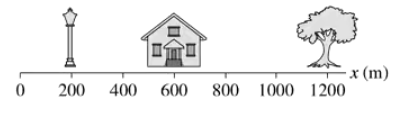
Larry leaves home at 9:05 and runs at constant speed to the lamppost seen in FIGURE EX2.1. He reaches the lamppost at 9:07, immediately turns, and runs to the tree. Larry arrives at the tree at 9:10. What is Larry's average velocity for the entire run?

Verified step by step guidance1
Step 1: Understand the problem. Larry's average velocity is defined as the total displacement divided by the total time taken. Displacement is a vector quantity, so it depends on the straight-line distance and direction from the starting point to the final point.
Step 2: Identify the total displacement. From the problem, Larry starts at home, runs to the lamppost, and then to the tree. To calculate the displacement, determine the straight-line distance and direction from the starting point (home) to the final point (tree). Use the positions provided in FIGURE EX2.1 to find this displacement.
Step 3: Calculate the total time taken. Larry starts at 9:05 and finishes at 9:10. The total time is the difference between these two times, which is 5 minutes. Convert this time into seconds for consistency in SI units: \( 5 \times 60 = 300 \) seconds.
Step 4: Use the formula for average velocity: \( \text{Average Velocity} = \frac{\text{Total Displacement}}{\text{Total Time}} \). Substitute the total displacement (calculated in Step 2) and the total time (300 seconds) into this formula.
Step 5: Ensure the direction of the average velocity is specified. Since velocity is a vector, include the direction of the displacement (from home to the tree) in your final expression for average velocity.

Verified video answer for a similar problem:
This video solution was recommended by our tutors as helpful for the problem above.
Video duration:
5mWas this helpful?
Key Concepts
Here are the essential concepts you must grasp in order to answer the question correctly.
Average Velocity
Average velocity is defined as the total displacement divided by the total time taken. It is a vector quantity, meaning it has both magnitude and direction. In this scenario, to find Larry's average velocity, we need to determine his overall change in position from his starting point to his final position and the total time he took for the run.
Recommended video:
Guided course
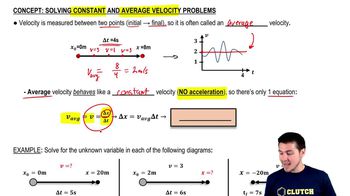
Solving Constant and Average Velocity Problems
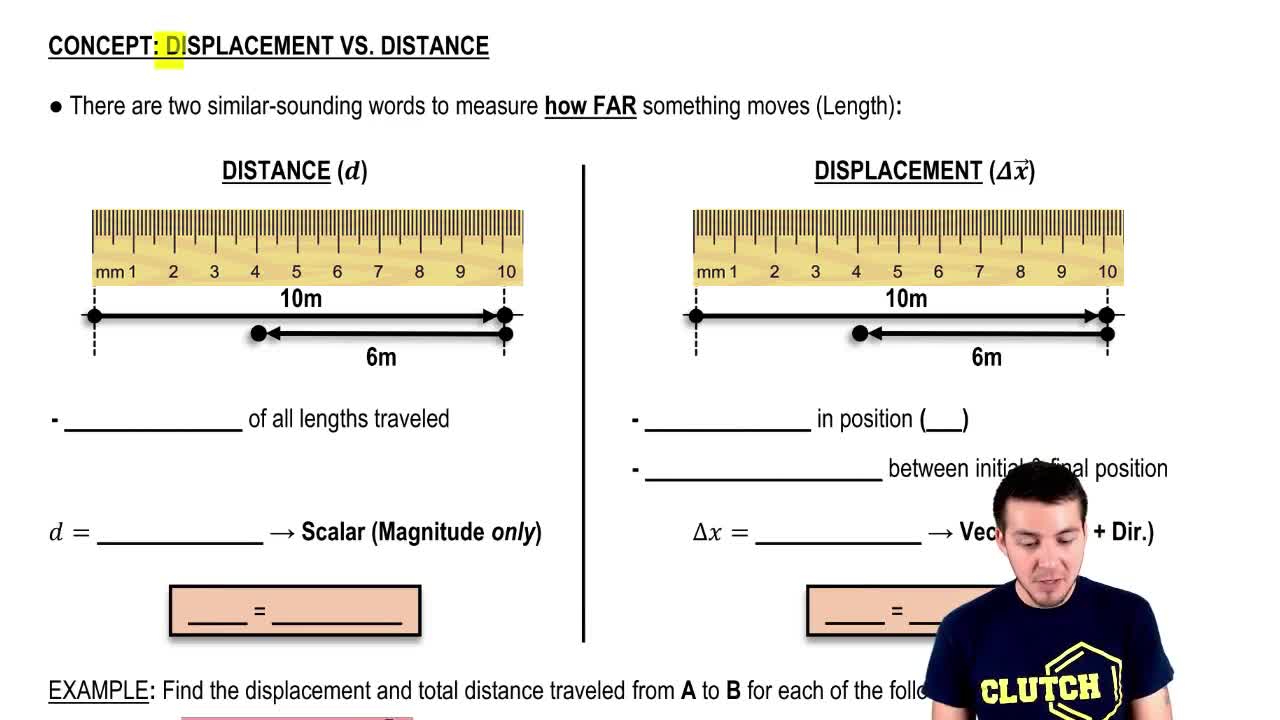
Displacement vs. Distance
Displacement refers to the shortest straight-line distance from the initial to the final position, along with the direction, while distance is the total path length traveled regardless of direction. In calculating average velocity, displacement is crucial as it directly influences the average velocity value, unlike distance which may not reflect the true change in position.
Recommended video:
Guided course
Displacement vs. Distance
Constant Speed
Constant speed means that an object covers equal distances in equal intervals of time, regardless of the direction of travel. In Larry's case, running at constant speed implies that his speed does not change during his run to the lamppost and then to the tree, allowing us to simplify calculations related to time and distance when determining average velocity.
Recommended video:
Guided course
Phase Constant of a Wave Function
Related Practice
Textbook Question
3
views
Textbook Question
Larry leaves home at 9:05 and runs at constant speed to the lamppost seen in FIGURE EX2.1. He reaches the lamppost at 9:07, immediately turns, and runs to the tree. Larry arrives at the tree at 9:10. What is Larry's average velocity, in, during each of these two intervals?
10
views
Textbook Question
FIGURE EX2.4 is the position-versus-time graph of a bicycle. What is the bicycle's velocity at t = 5s
2
views
Textbook Question
FIGURE EX2.4 is the position-versus-time graph of a bicycle. What is the bicycle's velocity at t = 30s?
1
views
