
Ch 02: Kinematics in One Dimension
Knight Calc - Physics for Scientists and Engineers 5th Edition
Knight Calc5th EditionPhysics for Scientists and EngineersISBN: 9780137344796Not the one you use?Change textbook
Chapter 2, Problem 1a

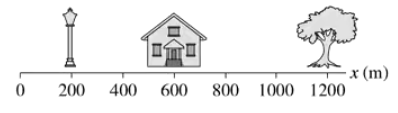
Larry leaves home at 9:05 and runs at constant speed to the lamppost seen in FIGURE EX2.1. He reaches the lamppost at 9:07, immediately turns, and runs to the tree. Larry arrives at the tree at 9:10. What is Larry's average velocity, in, during each of these two intervals?

Verified step by step guidance
1
Step 1: Understand the problem. Larry's motion is divided into two intervals: (1) from his house to the lamppost, and (2) from the lamppost to the tree. We need to calculate the average velocity for each interval. Average velocity is defined as the displacement divided by the time taken.
Step 2: Analyze the first interval. From the diagram, Larry starts at his house (x = 0 m) and runs to the lamppost (x = 5000 m). The displacement for this interval is Δx = x_final - x_initial = 5000 m - 0 m = 5000 m. The time taken is from 9:05 to 9:07, which is Δt = 2 minutes = 120 seconds.
Step 3: Calculate the average velocity for the first interval using the formula: v_avg = Δx / Δt. Substitute the values: Δx = 5000 m and Δt = 120 s.
Step 4: Analyze the second interval. Larry runs from the lamppost (x = 5000 m) to the tree (x = 2200 m). The displacement for this interval is Δx = x_final - x_initial = 2200 m - 5000 m = -2800 m (negative because he is moving back). The time taken is from 9:07 to 9:10, which is Δt = 3 minutes = 180 seconds.
Step 5: Calculate the average velocity for the second interval using the formula: v_avg = Δx / Δt. Substitute the values: Δx = -2800 m and Δt = 180 s.

Verified video answer for a similar problem:

This video solution was recommended by our tutors as helpful for the problem above.
Video duration:
3m
Was this helpful?

Key Concepts

Here are the essential concepts you must grasp in order to answer the question correctly.

Average Velocity

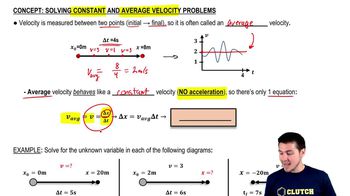
Average velocity is defined as the total displacement divided by the total time taken. It is a vector quantity, meaning it has both magnitude and direction. In this scenario, Larry's average velocity can be calculated for each segment of his run by determining the distance he traveled in each interval and the time taken for that travel.
Recommended video:
Guided course
05:44
Solving Constant and Average Velocity Problems

Displacement

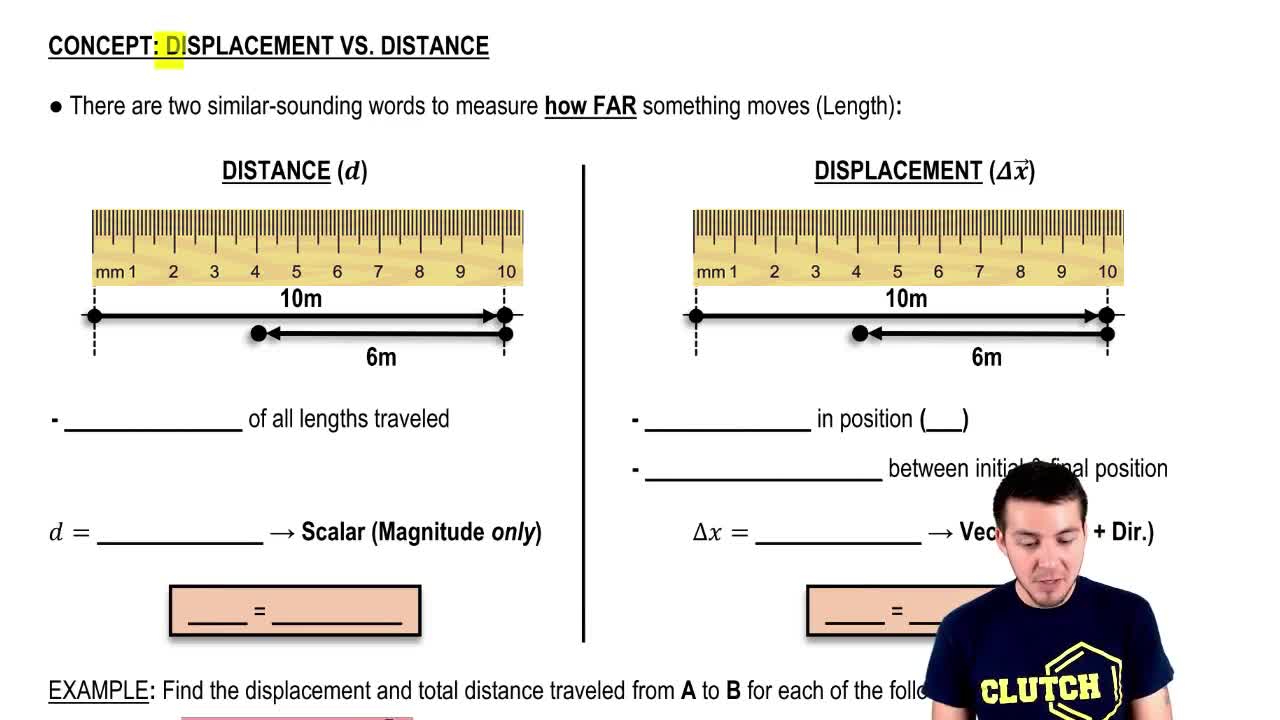
Displacement refers to the change in position of an object and is a vector quantity. It is calculated as the final position minus the initial position. In Larry's case, displacement will be important for determining his average velocity as it considers the straight-line distance from his starting point to his endpoint, regardless of the path taken.
Recommended video:
Guided course
06:13
Displacement vs. Distance

Constant Speed

Constant speed means that an object covers equal distances in equal intervals of time, regardless of the direction of travel. In Larry's run, he maintains a constant speed while moving to the lamppost and then to the tree, which simplifies the calculation of average velocity since the speed does not change during each segment of his journey.
Recommended video:
Guided course
08:59
Phase Constant of a Wave Function