Ch 02: Kinematics in One Dimension
Knight Calc - Physics for Scientists and Engineers 5th Edition
Knight Calc5th EditionPhysics for Scientists and EngineersISBN: 9780137344796Not the one you use?Change textbook
Chapter 2, Problem 74

A rocket in deep space has an empty mass of 150 kg and exhausts the hot gases of burned fuel at 2500m/s . It is loaded with 600 kg of fuel, which it burns in 30 s. What is the rocket's speed 10 s, 20 s, and 30 s after launch?

Verified step by step guidance
1
Step 1: Understand the problem and identify the key concepts. This problem involves the application of the rocket equation (Tsiolkovsky rocket equation) and the principle of conservation of momentum. The rocket's speed at different times depends on the mass of the rocket and the fuel burned, as well as the exhaust velocity of the gases.
Step 2: Write down the Tsiolkovsky rocket equation: v=veln(mi/mf), where v is the rocket's velocity, ve is the exhaust velocity, mi is the initial mass, and mf is the final mass at a given time.
Step 3: Calculate the initial mass of the rocket (mi) and the rate of fuel consumption. The initial mass is the sum of the empty mass and the fuel mass: mi=150+600=750 kg. The fuel consumption rate is 600/30=20 kg/s.
Step 4: Determine the mass of the rocket at 10 s, 20 s, and 30 s. At time t, the remaining fuel mass is 600-20t. Add this to the empty mass to find the total mass: mf=150+(600-20t).
Step 5: Use the rocket equation to calculate the velocity at each time point. Substitute ve=2500 m/s, mi=750 kg, and the calculated mf values for 10 s, 20 s, and 30 s into the equation: v=2500ln(750/mf). Perform the logarithmic operation for each time point to find the respective velocities.

Verified video answer for a similar problem:

This video solution was recommended by our tutors as helpful for the problem above.
Video duration:
9m
Was this helpful?

Key Concepts

Here are the essential concepts you must grasp in order to answer the question correctly.

Rocket Equation

The rocket equation, also known as Tsiolkovsky's equation, describes the motion of vehicles that follow the principle of conservation of momentum. It relates the change in velocity of a rocket to the effective exhaust velocity and the mass of the rocket before and after burning fuel. This equation is crucial for calculating the speed of the rocket as it expels fuel.
Recommended video:
Guided course
08:25
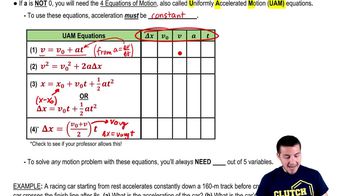
Kinematics Equations

Conservation of Momentum

Conservation of momentum is a fundamental principle in physics stating that the total momentum of a closed system remains constant if no external forces act upon it. In the context of a rocket, as it expels gas in one direction, it gains momentum in the opposite direction, allowing it to accelerate. This principle is essential for understanding how the rocket's speed changes as it burns fuel.
Recommended video:
Guided course
05:58
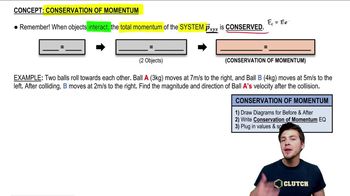
Conservation Of Momentum

Thrust and Fuel Consumption

Thrust is the force that propels a rocket forward, generated by the expulsion of exhaust gases. The rate of fuel consumption affects both the thrust produced and the mass of the rocket over time. Understanding how thrust changes with fuel consumption is vital for calculating the rocket's speed at different intervals after launch, as it directly influences the rocket's acceleration.
Recommended video:
Related Practice
Textbook Question

A rocket is launched straight up with constant acceleration. Four seconds after liftoff, a bolt falls off the side of the rocket. The bolt hits the ground 6.0 s later. What was the rocket's acceleration?

2
views

Textbook Question

When a 1984 Alfa Romeo Spider sports car accelerates at the maximum possible rate, its motion during the first 20 s is extremely well modeled by the simple equation vx2 = (2P/m)t, where P = 3.6 ✕ 10⁴ watts is the car's power output, m = 1200 kg is its mass, and vx is in m/s. That is, the square of the car's velocity increases linearly with time. Find an algebraic expression in terms of P, m, and t for the car's acceleration at time t.

1
views
Textbook Question

David is driving a steady 30 m/s when he passes Tina, who is sitting in her car at rest. Tina begins to accelerate at a steady 2.0 m/s² at the instant when David passes. What is her speed as she passes him?

4
views
Textbook Question

A good model for the acceleration of a car trying to reach top speed in the least amount of time is a𝓍 = a ─ kv𝓍, where a is the initial acceleration and k is a constant. Find an expression for the car's velocity as a function of time.

2
views
Textbook Question

A good model for the acceleration of a car trying to reach top speed in the least amount of time is ax = a0 ─ kvx, where a₀ is the initial acceleration and k is a constant. Find an expression for k in terms of a0 and the car's top speed vmax.

1
views
Textbook Question

If a Tesla Model S P100D in 'Ludicrous mode' is pushed to its limit, the first 3.0 s3.0\(\text{ s}\) of acceleration can be modeled as

ax={(35m/s3)t0 st0.40s14.6m/s2(1.5m/s3)t0.40st3.0sa_{x}=\(\begin{cases}\)(35\,\(\text{m/s}\)^3)t & 0\(\text{ s}\]\le\) t\(\le\)0.40\,\(\text{s}\)\\ 14.6\,\(\text{m/s}\)^2-(1.5\,\(\text{m/s}\)^3)t & 0.40\,\(\text{s}\[\le\) t\(\le\)3.0\,\(\text{s}\]\end{cases}\)

What acceleration would be needed to achieve the same speed in the same time at constant acceleration? Give your answer as a multiple of gg.

3
views