
Textbook Question
A rocket is launched straight up with constant acceleration. Four seconds after liftoff, a bolt falls off the side of the rocket. The bolt hits the ground 6.0 s later. What was the rocket's acceleration?
2
views

 Verified step by step guidance
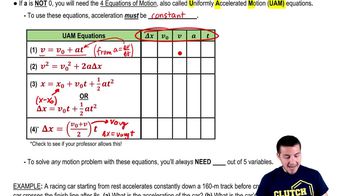
 08:25
08:25
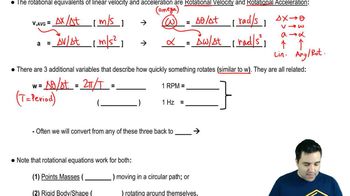 11:21
11:21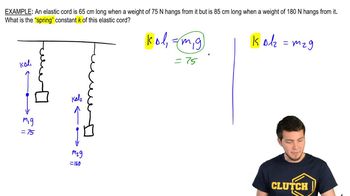 04:40
04:40A rocket is launched straight up with constant acceleration. Four seconds after liftoff, a bolt falls off the side of the rocket. The bolt hits the ground 6.0 s later. What was the rocket's acceleration?
A rubber ball is shot straight up from the ground with speed v₀. Simultaneously, a second rubber ball at height h directly above the first ball is dropped from rest. At what height above the ground do the balls collide? Your answer will be an algebraic expression in terms of h, v₀, and g.
A sprinter can accelerate with constant acceleration for 4.0 s before reaching top speed. He can run the 100 meter dash in 10.0 s. What is his speed as he crosses the finish line?
A good model for the acceleration of a car trying to reach top speed in the least amount of time is ax = a0 ─ kvx, where a₀ is the initial acceleration and k is a constant. Find an expression for k in terms of a0 and the car's top speed vmax.
A rocket in deep space has an empty mass of 150 kg and exhausts the hot gases of burned fuel at 2500m/s . It is loaded with 600 kg of fuel, which it burns in 30 s. What is the rocket's speed 10 s, 20 s, and 30 s after launch?
Careful measurements have been made of Olympic sprinters in the 100 meter dash. A quite realistic model is that the sprinter's velocity is given by v𝓍 = a ( 1 - e⁻ᵇᵗ ) where t is in s, v𝓍 is in m/s, and the constants a and b are characteristic of the sprinter. Sprinter Carl Lewis's run at the 1987 World Championships is modeled with a = 11.81 m/s and b = 0.6887 s⁻¹. Find an expression for the distance traveled at time t.