Ch 01: Concepts of Motion
Knight Calc - Physics for Scientists and Engineers 5th Edition
Knight Calc5th EditionPhysics for Scientists and EngineersISBN: 9780137344796Not the one you use?Change textbook
Chapter 1, Problem 28d

Perform the following calculations with the correct number of significant figures.
16.5/3.45

Verified step by step guidance
1
Step 1: Understand the concept of significant figures. Significant figures are the digits in a number that carry meaningful information about its precision. For division, the result should have the same number of significant figures as the number with the least significant figures in the calculation.
Step 2: Identify the number of significant figures in each value. The number 16.5 has three significant figures, and the number 3.45 also has three significant figures.
Step 3: Perform the division operation symbolically. Divide 16.5 by 3.45, which can be expressed as: 16.53.45.
Step 4: Round the result of the division to three significant figures, since both numbers in the calculation have three significant figures. This ensures the result maintains the correct precision.
Step 5: Verify the rounding process by checking the digits after the third significant figure. If the digit immediately following the third significant figure is 5 or greater, round up; otherwise, round down.

Verified video answer for a similar problem:

This video solution was recommended by our tutors as helpful for the problem above.
Video duration:
1m
Was this helpful?

Key Concepts

Here are the essential concepts you must grasp in order to answer the question correctly.

Significant Figures

Significant figures are the digits in a number that contribute to its precision. This includes all non-zero digits, any zeros between significant digits, and trailing zeros in the decimal portion. When performing calculations, the result should reflect the precision of the least precise measurement involved, ensuring that the final answer is reported with the correct number of significant figures.
Recommended video:
Guided course
04:44
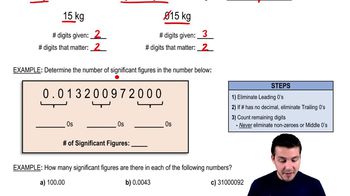
Counting Significant Figures

Division in Calculations

In division, the result should be rounded to the same number of significant figures as the measurement with the fewest significant figures. This rule ensures that the uncertainty in the measurements is appropriately reflected in the final answer. For example, when dividing 16.5 (three significant figures) by 3.45 (three significant figures), the result should also be expressed with three significant figures.
Recommended video:
Guided course
04:15
Calculating Dot Product Using Vector Components

Rounding Rules

Rounding rules dictate how to adjust numbers to the correct number of significant figures. If the digit to be dropped is less than five, the last retained digit remains unchanged; if it is five or greater, the last retained digit is increased by one. This process is crucial in ensuring that the final answer maintains the appropriate level of precision based on the significant figures of the original numbers.
Recommended video:
Guided course
04:08
Kirchhoff's Junction Rule