Ch 01: Concepts of Motion
Knight Calc - Physics for Scientists and Engineers 5th Edition
Knight Calc5th EditionPhysics for Scientists and EngineersISBN: 9780137344796Not the one you use?Change textbook
Chapter 1, Problem 34

A jet plane is cruising at 300 m/s when suddenly the pilot turns the engines up to full throttle. After traveling 4.0 km, the jet is moving with a speed of 400 m/s. What is the jet's acceleration as it speeds up?

Verified step by step guidance
1
Step 1: Identify the known quantities in the problem. The initial velocity of the jet is \( v_0 = 300 \; \text{m/s} \), the final velocity is \( v_f = 400 \; \text{m/s} \), and the distance traveled is \( d = 4.0 \; \text{km} \) (convert this to meters: \( d = 4000 \; \text{m} \)).
Step 2: Recall the kinematic equation that relates acceleration, initial velocity, final velocity, and displacement: \( v_f^2 = v_0^2 + 2ad \), where \( a \) is the acceleration and \( d \) is the displacement.
Step 3: Rearrange the equation to solve for acceleration \( a \): \( a = \frac{v_f^2 - v_0^2}{2d} \).
Step 4: Substitute the known values into the equation. Use \( v_0 = 300 \; \text{m/s} \), \( v_f = 400 \; \text{m/s} \), and \( d = 4000 \; \text{m} \).
Step 5: Perform the calculations to find the acceleration \( a \). Ensure that all units are consistent (meters and seconds) and simplify the expression to determine the value of \( a \).

Verified video answer for a similar problem:

This video solution was recommended by our tutors as helpful for the problem above.
Video duration:
2m
Was this helpful?

Key Concepts

Here are the essential concepts you must grasp in order to answer the question correctly.

Acceleration

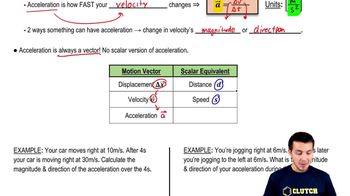
Acceleration is defined as the rate of change of velocity of an object with respect to time. It is a vector quantity, meaning it has both magnitude and direction. In this context, acceleration can be calculated by taking the difference in velocity and dividing it by the time taken to achieve that change. Understanding acceleration is crucial for analyzing how quickly the jet plane increases its speed.
Recommended video:
Guided course
05:47
Intro to Acceleration

Kinematics

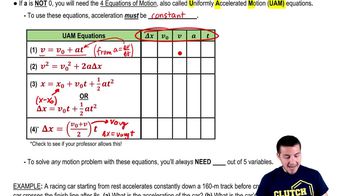
Kinematics is the branch of mechanics that deals with the motion of objects without considering the forces that cause the motion. It involves concepts such as displacement, velocity, and acceleration. In this scenario, kinematic equations can be used to relate the initial and final velocities of the jet, the distance traveled, and the time taken, which are essential for understanding the jet's motion.
Recommended video:
Guided course
08:25
Kinematics Equations

Velocity

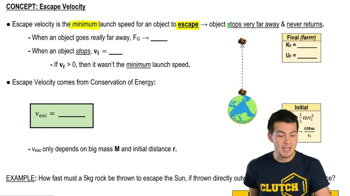
Velocity is a vector quantity that describes the rate of change of an object's position. It includes both speed and direction. In the given problem, the initial and final velocities of the jet plane are provided, which are critical for determining how the jet's speed changes over the distance traveled. Understanding velocity is fundamental to analyzing the jet's performance during its acceleration phase.
Recommended video:
Guided course
7:27
Escape Velocity