

Ch. 44 - Astrophysics and Cosmology
Giancoli Douglas - Physics for Scientists and Engineers 5th edition
Giancoli Douglas5th editionPhysics for Scientists and EngineersISBN: 9780137488179Not the one you use?Change textbook
Chapter 39, Problem 39

Calculate the peak wavelength of the CMB at 1.0 s after the birth of the universe. In what part of the EM spectrum is this radiation?

Verified step by step guidance
1
Understand the problem: The Cosmic Microwave Background (CMB) radiation is modeled as blackbody radiation. To find the peak wavelength, we use Wien's displacement law, which relates the temperature of a blackbody to the wavelength at which it emits the most radiation.
Recall Wien's displacement law: \( \lambda_{\text{max}} = \frac{b}{T} \), where \( \lambda_{\text{max}} \) is the peak wavelength, \( b \) is Wien's constant (\( b = 2.897 \times 10^{-3} \ \text{m·K} \)), and \( T \) is the temperature of the blackbody in kelvins.
Determine the temperature of the universe at 1.0 s after the Big Bang. From cosmology, the temperature of the universe at this time is approximately \( T = 10^{10} \ \text{K} \).
Substitute the values into Wien's displacement law: \( \lambda_{\text{max}} = \frac{2.897 \times 10^{-3}}{10^{10}} \). Simplify the expression to find the peak wavelength in meters.
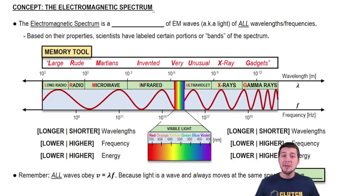
Interpret the result: Once the peak wavelength is calculated, determine which part of the electromagnetic spectrum it falls into. For example, if the wavelength is very short (on the order of nanometers), it would fall in the gamma-ray or X-ray region.

Verified video answer for a similar problem:

This video solution was recommended by our tutors as helpful for the problem above.
Video duration:
5m
Was this helpful?

Key Concepts

Here are the essential concepts you must grasp in order to answer the question correctly.

Cosmic Microwave Background (CMB)

The Cosmic Microwave Background (CMB) is the remnant radiation from the Big Bang, filling the universe and providing a snapshot of the early universe approximately 380,000 years after its birth. At 1.0 second after the Big Bang, the universe was still in a hot, dense state, and the CMB would have been at a much higher temperature than it is today, influencing its peak wavelength.
Recommended video:
Guided course
06:06
The Electromagnetic Spectrum

Wien's Displacement Law

Wien's Displacement Law states that the peak wavelength of radiation emitted by a black body is inversely proportional to its temperature. This means that as the temperature of the black body increases, the peak wavelength decreases. This law is crucial for calculating the peak wavelength of the CMB at different temperatures, particularly at the early stages of the universe.
Recommended video:
Guided course
06:13
Displacement vs. Distance

Electromagnetic Spectrum

The electromagnetic spectrum encompasses all types of electromagnetic radiation, ranging from gamma rays to radio waves. The CMB radiation, characterized by its peak wavelength, falls within the microwave region of the spectrum. Understanding where the CMB lies in the electromagnetic spectrum helps in identifying its properties and implications for cosmology.
Recommended video:
Guided course
06:06
The Electromagnetic Spectrum